Showing posts with label life in general. Show all posts

Sunday, May 28, 2023

Behind The Eight Ball

It started back in August,

The transition from delivery driving to tutoring,

Too many emails back and forth,

Not enough time to make deliveries,

Three-week delay until my first tutoring paycheck.

I’m behind the eight ball


End of September,

Busy with tutoring,

Lots of balls moving around,

So stressed trying to keep things straight,

That I made a mistake.

I’m still behind the eight ball


Winter break,

No kids to tutor,

People are cooking instead of ordering,

No quarantines,

Less deliveries,

The balls stop moving.

I’m stuck behind the eight ball


Second semester,

The schedule is nearly full,

But I’m playing catch up,

I love this job, and I am good at it,

I just don’t have enough students,

To stay afloat,

The balls are moving, but not a single tap.

I’m stuck behind the eight ball


Spring Break,

Another slow week,

Trying to brainstorm another plan,

To replace delivery driving,

Every option is beyond my abilities,

The stress and anxiety builds,

Whoops, another mistake,

A ball rolls by without a touch.

I’m stuck behind the eight ball


The year is almost over,

An unexpected problem,

I’m not prepared for this,

My head is swirling in worry,

About what else could happen,

The balls have disappeared.

I’m stuck behind the eight ball


Looking at summer,

My mental health is a mess,

I’ve fallen behind on everything,

I need to take time to heal, to prepare for fall,

When the need for tutors will grow,

But first I have to find the other balls.

Because I’m still stuck behind the eight ball


And I can’t seem to break free.

Saturday, January 1, 2022

The Three D’s

Remember two years ago, when I said the 20s were going to roar? 

Well, I didn’t mean a little virus was going to roar over us.  It’s been…quite a year.  No, quite a couple of years.

I love to spend New Years’ Day reflecting on the past year—and planning the next.  As I said in Bill’s This Time Next Year challenge, the lockdowns and furloughs and protocols have worn me down, and now, I am in the worst shape of my life, physically and mentally, since college.  Everything has fallen apart, and I feel completely broken.  And I am far from alone.

Despite all of the awful, I learned some very valuable lessons in 2021.  In February, I was diagnosed with Obsessive Compulsive Personality Disorder, finally understanding how my brain works.  I realized that all the time I have spent escaping into a dreamland was exactly what prevented me from chasing my dreams.  I wasn’t only using my dreams as an escape—I was using “self care” as an excuse to avoid the long, difficult pathway towards success. 

In these two years of ‘rona, I had forgotten what it was going to take….to live the life of my dreams.

Clearly, I need a reboot, and it starts with developing three qualities that all start with the letter D:

Determination.  Dedication.  Discipline.

Last year, I talked about the Grind, how to keep going when you’re tired or challenged or never believe you will succeed.  I had three goals, and while #blogsandcoffee has been a great success, I struggled to create a daily routine.  (Don’t even ask about the English accent.  I decided to start learning French instead.) 

The reason I failed at creating a daily routine—was that I wasn’t determined enough to be dedicated enough to have the discipline to make it happen.  I chose the instant gratification of dreams and indulgences, rather than working through the challenges from juggling so many balls in the air.

Did you know that people with OCPD struggle with multitasking?  Um, yeah.  I probably also need to learn how to say “no” more often….

Now, there are a lot of people reading this and thinking, “um, Erin, you are the most disciplined, dedicated person I know.  I mean, in high school/college/work/running you are so able to get it done.”

Well, I am…when it’s simple, like training for a marathon, or has triggered my compulsions, like writing this blog post, but once things get complicated, I can’t handle all that’s being thrown at me.  Like what we have to manage as an adult—work, home, finances, health, leisure—add in the stresses of covid, and I have lost my way. 

(I’m also really, really good at hiding my struggles.)

To succeed at this endeavor, I have to start simple, with one project I know I can do if I am determined, I am dedicated, and I am disciplined.  I need to appreciate the baby steps it will take to complete this project and do them, even when I’m tired or anxious or had a bad day.  It will be like filling a rain barrel with an eyedropper, so I have to use these three D’s to stay on track, progressing towards completion.

Once I have reached my goal with that first project, I repeat the process with another project, then another, and another, building my determination, my dedication, and my discipline with each iteration, empowering me to tackle increasingly difficult projects.

If I master these three D’s, perhaps I will have a daily routine by the end of the year, the first step towards the life of my dreams.

Wednesday, December 29, 2021

This Time Next Year

The only part of the holidays I love is the change of the year.  Having a slower time to reflect on the accomplishments of the past year and set goals (never resolutions) for the new year is probably my favorite holiday tradition.  Those of you regular readers know I start the year with a blog post, and last year, one of my goals was to create a place to read and support other bloggers.  I launched #blogsandcoffee on January 1st, and after only a year, I’ve made some great connections as other bloggers have used the hashtag to promote their blogs.  (Yes, I read every blog post I promote!)  One of my “regulars” is Bill from A Silly Place, who tagged me here.  His Sunday roundup blog is a must-read, and usually I make an extra-large cup of coffee so I can read what he’s found.  Thank you, Bill, for your tag—and your positive contribution to the Twitter blogging community.

Rules, rules rules

Because these things always come with rules:

  • Thank the person who tagged you.
  • Write your goals for next year.
  • Write how you’re going to achieve these goals.
  • Tag at least five blogger friends.
  • This last one is optional, but in 365 days, write a post about whether or not you’ve been successful!

At this time next year…

If I wanted to condense my goals into one word, it would be stability.

Like many people, I was completely unprepared for a global pandemic of lockdowns and furloughs.  Ever since the world shut down back in March of 2020, I’ve felt like I’m stuck on a tilt-a-whirl, struggling to hold on against the twists and turns, the ups and downs—the uncertainty—that filled every day.

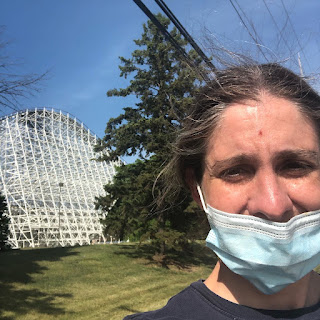
(I hate spinning rides.  I’ve lived 15 minutes from Great America for years, but haven’t visited it since 1995.)

The closest I've gotten to being inside the park...

As the days turned to weeks, weeks turned to months, and months turned to years, the whipping and the spinning had so filled my brain that even the simplest of tasks was a challenge.  My life was spinning out of control, fighting to keep it from falling completely off the rails….and lost. 

I need to find the lever, stop the ride, clear my head.  Stand on terra firma and feel normal again.

At this time next year, I see myself following a daily, regular routine.  The tasks I need to do to stay on top of things have become habits, giving my days an easy flow.  I go to bed feeling accomplished, confident that the next day will be successful, and wake up feeling rested and energized, my batteries recharged.  I have balance in my life, calming my mind, giving me the stability to work on the bigger projects, get my life together, and chase my dreams.

The details of how I’m going to do it…..will the subject of my New Years’ Day post.  (Hint:  it has to do with the letter “D.”)

Tag!  You’re it!

Rethink Entrepreneur

Tangela Williams-Spann

Amber

Headphones Thoughts

Aneesha Shewani

Saturday, May 1, 2021

Words Hurt as Much as Hands


“We should have never let you go to Lawrence.  You weren’t ready for college.”

I stopped, stunned.  “What did you say, Mom?”

“We watched the video from Colorado.  You were clearly miserable and not ready to go off to college. You should have stayed home and gone to MCC.”

Ah, Colorado.  The family vacation we took the summer after I graduated high school.  Since my school started much later than everyone else, my parents planned the trip in August….when all my friends were leaving for school.  Cue moody, miserable teenager.

This conversation, though, was many years later, when I was in my early 30s, and my parents were going through old photos and videos, one piece of the eventual sale of my childhood home.  It hurt to hear her discount all the hard work, all the scrimping and saving, all the effort we had taken as a family for me to get into—and afford—a rigorous, top-tier school.    

Today is May 1st, decision day, and that memory always creeps in my brain as I think about my students and their college choices.  Spring has bloomed with college decisions and Mother’s Day….and blue children all over Lake County to raise awareness of child abuse. 


A Blue Kid of Lake County to promote Child Abuse Awareness

It all reminds me of my rocky, difficult relationship with my mother.

“Look at those girls,” my mom is saying to junior high me.  “Do you see them laughing at you?”

“No, where?”  I glanced around and saw two girls I didn’t recognize, whispering and giggling.

Maybe they were laughing at me, but they didn’t cast an impression on me.  I was a bit of a contrarian as a junior high kid, the type of kid who had a clear sense of who she was and where she was going.  I had zero interest in hair and makeup and clothes and celebrities, but loved science and math and Anne MacCaffrey and old movies and The Weather Channel.  I was looking forward to leaving the insular, small universe of my elementary/junior high (yes, one building for K-8) for the larger suburban high school, where there was a chance there were more kids like me, or even that buzzer thing they did on Head of the Class.  (There was.  We won conference my senior year, and I was named to the all-conference team.  I hope that plaque is still hanging in the hallway.)

My mother, however, noticed every single glance, every single giggle, every single whisper, and made sure that I was given the feedback.

The actual teasing and whispers and drama and gossip wasn’t so bad; we were all uncomfortable and struggling.  It was having to come home and have to rehash it in detail that had me terrified every day.  Most of my memories of eighth grade were standing at the foot of my parents’ bed, going through my day with my mom, who was analyzing everything I did and said, trying to suggest how I could have handled it better.  Hours spent staring at the bed, the wallpaper, trying to figure out how to make the conversation stop.

But the conversation never really stopped.  Her voice whispers through me at every social gathering, noticing every look or stare or awkward moment, her post-mortems in my head on the way home.  I look in the mirror, tired, never able to escape the lecture. 

As children, we believe our parents are right.  They are acting in our best interests, and their unconditional love means they would never do harm.  They love us so much they would kill for us, right?  Just like we see in those PBS documentaries.

“Trying to get your ideas on paper is like pulling teeth.  What are you trying to say here?”  A mother in graduate school, helping her daughter get through World Literature in high school.  I swear, those Greek and Latin vocabulary lessons saved me so many times...

“What I wrote down.”

“Erin, it doesn’t make any sense.  Here, you should rewrite it this way.”

Despite working on her masters’ degree in social work, my mother was always willing to help me.  While science and math came easily to me, writing did not.  I loved to read, but I saw a very different world in the literature we were reading—and my need to put the words perfectly on paper impeded my ability to communicate those thoughts.

As we’ve learned this year, parents aren’t always the best person to teach their children, and this was a textbook example.  She didn’t have the training to help me in a way that would encourage me, and as someone where every other aspect of school came easily, the discouragement factor was high.  Every session eroded my confidence in my writing skills, to the point where I didn’t think I could complete an assignment without her help.

It took four tough, grueling, frustrating years at Lawrence before I believed I was an adequate writer.  Four years of writing and editing and essay tests and term papers.  I had chosen a school that required formal, written lab reports and math assignments.

Four years of doing The Grind.

While college isn’t this happy, idyllic memory, I am so grateful for the growth and strength it gave me.  A lot of who I am today came from those difficult times.  Perhaps that’s why my mother’s comments about those four years—and wishing she had kept me home—stung so much, even ten years after graduation. 

*****

“We’d go to teacher conferences, and they kept asking me, ‘why is she so afraid of you?’ I didn’t know what to say, because that’s not how you behave at home.”

Her tone was part frustration, part exasperation, and part accusatory.  My father was on the school board, while my mother was active in the PTA.  In a small school where many of my teachers were also parents, they knew my family, my home, and there were no red flags of abuse.  It didn’t make sense.

To her.  Here I was, in my thirties, and it was the first inkling that maybe her way of parenting wasn’t healthy or right for me.  When I started therapy and unpacking my childhood, I learned that her behavior had crossed the line towards abuse.

What we truly don’t understand until we become adults is that our parents are the products of their own childhoods, their own brokenness from their own parents.  Many abusers were actually victims of abuse, never having dealt with their own trauma, and children are very good at testing their parent’s patience.  Parents who don’t have the practice and skills to handle such difficult situations…make mistakes. 

I will never say that I was an easy child.  The double-whammy of high IQ and undiagnosed mental illness is tough for even the best of parents.  My mother was a fixer, needing to correct everything around her, while I was this mess of a brain that didn’t stop and couldn’t calm.  It was a perfect storm of conflict, the child who didn’t have the language to express the fireworks in her brain and the mother whose brain was so full of her own issues she didn’t have the skills to meet me at my level. 

Instead, she tore me down verbally to gain the upper hand.  As long as she held my self-esteem, I was controllable.  Easy to parent.

We see child abuse as fists and anger, torture and neglect, but we don’t think about the words.  Words of misunderstanding and frustration, words that break confidence and trust.  It’s words that make a daughter who worked on three patents in nanocomposite technology, who got a job with the US House of Representatives, who medaled at a national figure skating championships, who finished nine marathons—believe she is the black sheep of the family, too much a contrarian, a monster, a dictator to be included.

Words matter.  Understanding matters.  Parenting is a hard job, one that, knowing what I know now, is completely beyond my abilities.  Good thing I never did settle down and have children.  The cycle is broken.  Healing is happening, and maybe some day I’ll be able to look at my mother and not feel her disappointment in me.

Not hear her words in my head.

Monday, February 15, 2021

Hamster Wheels and Rabbit Holes

Nine years ago, reeling from having the rug pulled out from under me, I entered a therapist’s office and asked, “what is wrong with me?”

The same question everyone around me has been asking for decades.

After years of sorting through my life, there was a diagnosis:  Obsessive Compulsive Disorder.  The symptoms were there—fear of contamination, handwashing, checking things over and over again—but every time I tried to challenge those compulsions, my head filled not with fear, but rage.

Recently, I discovered the reason why treatment wasn’t working.  I don’t have Obsessive Compulsive Disorder.  I have the rarer and difficult to diagnose Obsessive Compulsive Personality Disorder. 

You know you hit the right disorder…when you read the description and are flooded with memories that completely match the symptoms.  It’s a relief to finally, finally have the right name for all this discomfort.

Then you realize you have a personality disorder.  Like, my personality is so far from normal that it’s “disordered.”  Time to resurrect that exceptional people book club, huh?

A man who turned his ALS diagnosis into great things...so why can't I?

Less than a week earlier, in response to a birthday text where a friend asked me how I was doing, I replied, “stuck on hamster wheels and lost down rabbit holes.”  Ironically, it’s a great description of what living with OCPD is like.

I feel like I’m on a hamster wheel, working so very hard to get things accomplished and checked off the list, but by the end of the day, having little to show for my efforts.  Even in these times, when the minutes drag by like hours, the days like weeks, and the months like years….the to do list seems to be growing instead of shrinking.  (Don’t ask about the bank account.  Spoiler alert:  it’s not growing nearly as fast.)

With OCPD, the organization and procedure for each task is detailed and precise.  Every step in the process has to be carefully thought out and planned.  If my brain even has one molecule of anxiety, I have to walk away and calm myself down.  And if the task isn’t done perfectly, I have to start from the beginning and redo it until it is perfect.

I probably look just like that hamster, expending all that energy with no forward progression. 


Pretty much my entire life....via GIPHY

Probably because I’m constantly getting stuck in rabbit holes I dug for myself.  You know when you put one thing away in the junk drawer, which leads you to organize the junk drawer, where you find that button that popped off a shirt a couple weeks ago, which leads you to find the shirt to sew the button, which leads to doing a load of laundry?  Rabbit hole. 

Well, I tend to dig a lot of them, and then proceed to get lost wandering around the resulting maze of tunnels.  It starts innocently enough with one task, like putting an item away in a drawer, but then I notice that the drawer needs to be cleaned.  As I’m taking out one item from the drawer to clean it, I notice it belongs in another room, but that space needs to be decontaminated before anything can go into there.  I start making a list of how to clean that space, and well, now that first item won’t get put away until I get that list completed.

Of course, life is what gets in the way of plans, and before I can finish that list, I have to sort the mail for an important document or clean out the car or get the laundry room ready for the possibility of something breaking and needing repair….

As I’m trying to fill up one rabbit hole, another dozen or so appear.  

At least, I keep thinking I do...

For years, I believed the issue was that I was lazy or disorganized or, dare I say it, stupid, to figure out how to function like a normal person.  I’ve spent a lot of time trying to fight my brain, which always wins, but now it’s time to figure out a life that works for how I’m wired.

It’s time to step off the hamster wheels and come out of the rabbit holes….and start writing the first chapter of the rest of my life.

Thursday, December 31, 2020

The Grind

I’ve been a chemistry tutor for over five years.  What started as helping out a friend has become a new career, and I’ve added math, including calculus, to the mix this year.  Gosh, I so missed solving hard math problems.

Many people think they’re bad at math because they don’t have all the answers instantaneously.  They don’t even know what skill they need to start a problem.  Chemistry is challenging because it’s usually the first time you’re using math to solve science—an entire year of those dreaded word problems.

One of the many secrets to mastering math and chemistry isn’t a formula or a cheat sheet or having mad skills.  It’s being able to attack each problem, each test question.  Look at what you’re given, look at what they want from you, and go from A to B.

How do you do that?  Practice.  The practice of doing many, many problems until you are able to attack anything that might be thrown at you.

It’s no different than anything else you practice—an instrument, a sport, an art.  In order to master any subject, you have to do the grind.  The grind of waking up and doing the same thing day after day.  The grind of focusing on perfecting each little detail.  The grind of continuing to move forward so slowly that you see more failure than success.  The grind of brushing yourself off after each failure and getting back on the path.

Over the years, people are in awe of my chemistry degree, like I have this amazing talent.  To be honest, it’s just that my love of the subject gave me the determination to grind out problem after problem.  I can’t sleep on an unsolved chemistry or math or computer programming problem, often waking at 2 am to finish what I started.  It just tumbles in my brain, crying to be solved, just like the baseball player down the street throwing curveballs at a net late on a summer evening or the oboe player next door playing the same measure of music over and over again on a Saturday morning.

Of course, it’s easy for someone with a passion for baseball or a talent for playing the oboe to do the grind, but have you ever heard someone express a huge passion for being a cog in a Corporate America cube farm?  How do you grind at something you don’t love?  That doesn’t come easily for you?

How many of you loved school when you were in second grade, but hated it by the time you were in high school because the classwork was just so hard?  How many of you grew up playing Little League or taking dance lessons or studying piano, but quit when it seemed that you had hit your limit? 

I joke that I’m the utility ballplayer of life because I’ve done so many things, but quit before I had mastered them.  I’m competent in a lot of skills, but not exceptional.  My resume goes from research chemist to quality consultant to executive director of a political party to tutor.  I’ve taken dance lessons and piano lessons and figure skating lessons.  I played clarinet in the school band, nine years total.  Even where I do have talents, math and science, didn’t help me push through the challenges in college.  I graduated with my degree, but barely.

It’s hard to believe that a year ago, I was on top of the world with my running, having negatively split New York through the hardest part of the course to break 5 hours and get my second fastest time.  2020 was supposed to be the year I took a break from racing to focus on how I could get that Boston qualifying time.  Then the world shut down, and my focus turned to survival.  As the months tickd by, and races continue to be cancelled, delayed, postponed, and modified, I thought about my quest to finish all six majors by my 50th birthday.  The deferments, the cancellations were definitely going to impede my ability to grab slots in Toyko or London once things returned to normal.  There’s usually half a million people who apply for those lotteries in a normal year, but what now?  As for Boston, losing one, if not two years for charity runners will make it even harder to get one of those coveted spots, and I’m so busy trying to survive that running has taken a back seat, derailing my efforts to qualify.

I have five years to get into three major marathons.  I’m barely scraping by, financially, my mental health is a mess, and there are now millions of runners who didn’t get the spots they thought they’d get this year.  How on earth am I going to finish this quest?

Then I thought of my students, past, present, and future.  How many of them feel dumb at school?  How many hate doing homework because they just don’t even understand the lesson?  How many want to give up and say they can’t do chemistry or math?

Tutoring isn’t just about AP exams and letter grades.  It’s about helping these kids overcome challenges, solve problems, and learn how they learn so they can apply these skills for the rest of their life.  Odds are that you won’t have to use the ideal gas law or Rolle’s Theorem in your 40s, but the skills that got you through those assignments and tests, will.

Just like my quest; it is more about the journey more than the end result.

In 2021, I need to figure out how to do the grind when it’s something that isn’t easy or fun or exciting or interesting.  After some soul-searching, I came up with three things I’d like to accomplish this year for three very different reasons.  They are all going to take that grind, though in different ways:

  1. British accent.  As a high school drama kid, I was always jealous of my classmates who could switch into a British accent without even thinking about it.  When I got a part in the fall play and had to do five lines in accent, I spent hours and hours listening to Brits read books on tape, trying to figure out the intonations and pronunciations, but never feeling like I got it right.  Now, with YouTube and Zoom and all sorts of tools (there has to be an app, right?), as well as maturity and wisdom, perhaps I can master something that I was convinced I couldn’t.
  2. Daily routine.  It’s been a year, right?  As I navigated the roller coaster of part time work and furloughs, I saw a lot of my regular maintenance routines falling apart from running to brushing my hair every morning.  I’ve put down the list of things I do want to accomplish every day.  It may not be fun or exciting, but going through the steps to get my life reset will do wonders for my mental health.  (If you were wondering about running, it’s part of this routine.  Baby steps.)
  3. Blogs and Coffee.  As part of my daily routine, I’m reading blogs I find on Twitter over my morning coffee.  I had a great idea a couple of days ago to use the hashtag #blogsandcoffee to share the blogs that I’m reading.  Now, I’ve had a lot of great ideas over the years that get lost on the wayside for a number of reasons, so my goal here is to post #blogsandcoffee every single day in 2021, even if it’s a tweet to say why there wasn’t a #blogsandcoffee.  Maybe it will develop a following, maybe it won’t, but at least I ground through the challenges and finished what I started.

Unlike most New Years resolutions, which have an endpoint, I am creating a focus, an intention, to grow as a person, regardless of whether or not I meet my goals.  If I figure out how to grind through things I don’t enjoy, it’s powerful—and it’s a power I can teach my students so they can succeed, whether it’s third grade math or AP Physics.

Also, rather than a personal, specific goal, it’s a theme we can all take together.  Let’s face it.  2020 was a struggle in many ways.  We survived, but not without damage.  We’re not the same people who started this year, but to continue to thrive, we need to continue to evolve.  We need to grind through our challenges, whether it’s AP Calculus or working from home or figuring out how to change the oil on the car.  What are you needing to grind through in 2021? 

Sunday, December 13, 2020

Please, Don’t Fix Me

Last time, I talked about how I’m putting stuff I want out of my life on FB Marketplace.  I’ve had people over the past couple of years suggest to me that they would come over, clear out the stuff, and wouldn’t I feel so much better without the clutter?  Isn’t that just an easy thing to do, and then everything would be fixed?

To be honest, no.  This process of choosing an item, listing it, and selling it is giving me a great deal of pleasure.  As well as a few extra dollars for the savings account.  I enjoy the ability to give each item the time I need to make a decision, instead of having the stress of making hundreds of decisions in one day. 

Besides, why do I have to complete this project so quickly? 

I don’t have a spouse.  I don’t have children.  My cat just doesn’t care.  (Seriously, as long as she gets one spoonful of wet food with gravy, lap time, and scritches, she’s pretty happy.)

Nobody is depending on me to finish by a certain date, so it’s nice to have something that is completely on my terms, within my complete control, according to my plan.  So little in life is like that, and instead of stressed, I’m calmed by this process.  It’s been an adventure instead of a chore.

I mean, who doesn't want an antique rocking chair?
(Santa, lamp, and pan not included.)

Perhaps that’s why, when people ask me for marathon running advice, my response is simple:  own your training journey, because that’s what will take you through race day.  You need to do what makes sense for you, not what other people tell you to do.

I’m not running those 26.2 miles….you are, so you need to feel proud and determined and successful as you wait in the starting corrals.  That happens when you prepare on your own terms, taking the information you like and ignoring the information that doesn’t work for you. 

It’s such different advice than I’ve received through my journey in this world.  People like to fix problems, so when they hear about an issue, they often blurt out the solution that works for them, whether it’s why you’re stuck around a 5:30 marathon or have a cluttered house or are struggling with a relationship or unhappy at work or have a phone with 30% charge on it.  They so want to alleviate the anxiety in the air, and it worked for them, so why not everyone else?

Well, we’re all different.  All. Of Us. 7. Billion. Humans.  We are all going to have different dreams, different challenges, different belief systems, different ways of seeing a problem.  Your “simple” solution may not be the best for the person with ADD.  Or dyslexia.  And definitely not someone with OCD.

Instead of jumping to fix everyone else’s issues, why not just listen?  Why not just ask questions to help clarify?  Why not help the person find what works for them instead of telling them what they should do?  And if they say, “I’m okay, thank you,” let it go.

While the solution may seem completely obvious to you, there’s power in the process of problem solving.  When you give someone the space to own their solution, you give them the confidence to grow and learn and be even better than they ever imagined.  It’s an uncomfortable space, letting someone sit with their issue that appears easily solvable, but usually, the end result is beyond your expectations.

Instead of asking someone to conform to you, you’re empowering them to be exceptional.

So please don’t fix me.  I’m on my own path to healing, thank you very much, and as I grow from this process, great things will happen.  Well, at least a few hundred dollars from FB Marketplace sales….

Monday, November 30, 2020

My OCD as a Superpower

Just like my morning cup of coffee, I need to have every single step of my day organized in my head.  It allows me to go through everything smoothly, like a choreographed dance, calming and clearing my mind so I have the energy and focus to pursue my dreams.  It’s as satisfying as setting up a domino show, then watching it tumble:


Isn't that soothing to watch?  The order, the organization, the choreography....

Life, however, almost never operates that easily.  As things start falling off the rails, my head starts filling with anxious noise.  I’m thrown into a tizzy of multiple thought streams speeding across my neural net, rendering me unable to focus on any one item for more than a few seconds.  The noise will escalate until I can barely see or hear or feel the real world, my brain completely disconnected by the overloaded circuits.  I can even be so stressed that I struggle to breathe.

I need to take some time, calm my head, clear my brain, and reset the dominoes.  Sometimes, it’s just a few breaths or a walk around the block or completing an online survey or playing a video game or taking care of something that is hanging over me.  Other times, I escape to dreamland, wishing for a life without worry.  Occasionally, I can get so agitated that I have to lie down and take a nap just to avoid a major panic attack. 

While I’m doing all these things to soothe my overwhelmed, overloaded brain back to coherent thought, time continues to march forward, as do the schedules and deadlines and time limits that trigger my anxiety in the first place.  No wonder I’m always pressed—or stressed—for time.  I never have enough time to finish a project or respond to someone or get somewhere because it just takes more time than I have.

Time becomes my enemy, and as the clock ticks, so does my anxiety, and as everything churns inside me, I start having the urge to act impulsively.

Sigh.  The only thing worse than my relationship with time….is my relationship with impulsivity.

The beauty about having my head organized is feeling clear and calm and able to make thoughtful, reasoned decisions.  I love being thoughtful, being able to think things through, being able to plan my decisions and their ramifications. 

As I start stressing over how little time I have to get things done, my mind fills with panicked responses, ways to get the anxiety to clear as quickly as possible.  I no longer care about being thoughtful or kind or considerate.  I no longer care if I’m doing the job okay.  I no longer care about anyone else’s feelings.  I just want the chaotic mess out of my brain and back to calm and organized.

If I react to these impulsive feelings, it never ends well.  I’ve lied and cheated.  I’ve done work that was so careless and awful that it had to be redone.  I’ve said horrible, hurtful things to people.  I’ve made terrible mistakes.  I’ve destroyed things that I had so carefully built.  In the attempt to alleviate the chaos, I end up creating a bigger mess and losing even more time to the anger and panic.

I cannot give into this insanity, and yet, life often forces me to do so.  I’m filled with regret over the impulsive decisions I’ve made over the years, many of which haunt me decades later.   

Which brings me to my garage.  It’s filled with an eclectic collection of stuff my ex-boyfriend acquired in an attempt to start a reseller business, but never could get it off the ground.  What do you do when a global pandemic hits after you’ve drained your emergency savings?  You start selling things. 

Any day when I’m not working my other three (!) jobs, I’m in the garage, listing his random stuff online.  It’s actually been cathartic to go through this process of selling each item, feeling like I’m stepping closer to financial freedom.  However, I tend to be a little impulsive about pricing…..


I priced these cards from the 1970s for $5.  Whoops.

What do you expect happens when I am selling things like electronics and tools and collectables at bottom-barrel prices in a county with a population of 700,000?  Yup, my phone blows up like Jennifer Aniston’s did when she joined Instagram.  (Okay, maybe not that much, but I’ve gotten some serious empathy for those IG folks with millions of followers.)  it’s absolutely insane how crazed people get about a computer monitor I can’t guarantee works or a power drill without a battery, just because it’s only $5.

Most of the responses are male, and clearly impulsive.  They are willing to run out the door and fly straight to my house to pick up the item, lest I sell to someone else.  They offer more money than I’m listing in hopes that they can jump ahead in line.  Their overly forward, determined behavior to mow down every obstacle in their way is unsettling, to say the least, especially for someone is often already stressed and overwhelmed by time and impulsive behavior.

In this chaos, my OCD becomes my superpower, treating the madness with rigid rules to implement calm and organization.  My response to the impulsive insanity is on my timeline, a timeline that allows me to feel calm and organized.  If I feel the need to impulsively respond, I set the phone down and wait until I’ve thought through my response.  What’s amazing is by controlling the timeline and refusing to be impulsive, these guys calm down as well, becoming much easier to work with as they realize I’m going to be fair and considerate and thoughtful.  Probably why I’m a highly rated seller.

Now to harness this superpower and apply it to other aspects of my life.  And yes, to double my prices on Marketplace…..


Sunday, November 8, 2020

Finding My Way out of Dreamland

I have a coffee cup that says, “Stop Dreaming and Start Doing.”  It’s one of those mantras we see everywhere, from wall hangings to planners to….well, coffee cups.

Are you dreaming, or are you doing?


One day last week, I intentionally chose that cup because lately, it’s felt like I’ve spent more time dreaming and less time doing. 

Then my toilet clogged, triggering my contamination OCD and just making me too anxious to do anything beyond the bare minimum.  I went to bed, frustrated at what little “doing” I was able to accomplish.  However, I did a great job dreaming my day away, fantasizing about a life where everything was just…easier.

Dreaming has been my coping mechanism ever since I learned to read.  Falling into books, creating characters, being the person I wish I was instead of the person I saw in the mirror.  As a child, I would hide in my room, acting out the scenes I created to alleviate the stresses from school and home and a Mensa-level IQ and an undiagnosed mental illness.  (OCD is something you’re born with, and I knew it was the right diagnosis when my childhood memories and motivations suddenly made sense.)  No wonder at times of stress, I would lose myself in a fantasy of my own creation.

This time, however, the message on the mug stayed with me.  I’d fallen into my fantasy so deep that it was running as a continual stream in the back of my head, impeding my ability to function on a daily basis.  My escape from stress and anxiety was now creating so much noise that I couldn’t focus on anything.  I would read emails and not remember a word of content.  I would complete a task and then redo it, having completely forgotten that I had just done it.  I would ignore the people in my real world, preferring the interactions of the scenes in my head.

Looking backwards, it makes sense.  Before there was a global pandemic, I had run out of savings.  Before I ran out of savings, I had a horrible ending of a four-year relationship.  Before my ex and I broke up, I had a complete mental breakdown.  Before the breakdown, I quit my job to save my mental health.  The need for escapism was real, but it had gone too far and too deep.  I was now lost in my dreamworld, avoiding reality at all costs.

I looked back even further and saw the hours I spent over the years dreaming about what could be, rather than doing the hard work to make these dreams happen.  Pursuing your dreams…..is hard.  It’s the grind of plinking forward, failing, picking yourself up, and plinking forward again.  It’s fighting the boredom and the burnout and the monotony of spending so much time on something with so little progress.  It’s dealing with challenges and roadblocks and people who think you aren’t worthy. 

Just like….running a marathon.  Or nine.  Why was I able to do that and not this?

In my real life, I’ve always felt powerless and silent, not worthy of attention.  As a child, my mom would tell me that it was best if I didn’t speak my mind because she feared me being rejected by society.  I bit my tongue, became invisible, and created an alternate world in my mind where my ideas were valued and appreciated.

Fast forward to January 1, 2020.  I decided it was time to start writing down my ideas, my scripts, my scenes, my stories.  Then the world turned upside down with the coronavirus, and I lost my way, reality being so grim that my dreamworld was my only safe place.  We all have been finding some form of escapism this year, whether it is getting lost in video games, social media, Netflix binges, or scenes being played out in my own house.  We all need an escape right now. 

But for there to be any possibility for my dreams to come true, I need to leave my dreamland behind and re-engage with reality.

Instead of dreaming, I need to be writing down my dreams.  Instead of watching YouTube videos, I need to be watching Khan Academy videos.  Instead of disconnecting into fantasies, I need to be connecting with people. 

Just like the mug said, instead of dreaming, I need to be doing.

Tuesday, August 25, 2020

Paradigms, Masks, and All the Anger from Paradigms and Masks

My freshman year of college, I had to read a book called The Structure of Scientific Revolutions by Thomas Kuhn.  It blew my mind.  I was the science loving kid who talked in her college essays of the random science experiments she did with her makeup set when she was 5 and the hours spent watching clouds pass overhead, her inner meteorologist wishing for a storm.  Science was truth.  Facts.  Unbiased.  Solid.

Kuhn, a University of Chicago professor, had a different idea.  Ever hear the term, “paradigm shift?”  That was his idea.  What we think today about science can change, based on new information and data.  When he wrote it in the early 1960s, it took off enough that “paradigm shift” entered the modern vernacular, but his second idea didn’t.  It was that science is a series of paradigm shifts that take us closer to the truth. 

I loved it.  Whether looking at Galileo and Newton or the science section of the Sunday newspaper, every discovery, small or large, shifted the paradigm.  The study of facts and laws had become a journey of problem solving to get closer to the truth.

It was the start of four years where science wasn’t the study of facts but the study of what truth could be.  Classes where I manipulated virus DNA and played with organic dyes, and a senior year studying the paleoclimatology of the Lake Winnebago region of Wisconsin for an attempt at an honors thesis I was just too exhausted by May to finish.  In that process, I learned the journey toward the truth wasn’t always easy or kind or simple.

Fast forward to this January, as I started hearing about a novel coronavirus appearing in Wuhan, China.  Having a friend living there, I followed the story fairly closely as it traveled to Europe and Kirkland, WA, and New York City.  Suddenly, the paradigms that had served the CDC well during SARS and MERS and H1N1 didn’t work, and we were plunged into lockdown, with everything closed except the essentials. 

Kuhn, it seems, served me well.  I understood that we were in a situation with so many unknowns—so many variables—that we were far from the truth, and as such, were in for a roller coaster of paradigm shifts.  I expected changes and conflicting information as the scientists worked tirelessly to get closer and closer to the truth.

Which comes to masks.  With so little known about what would be called Covid-19 (or Covid for short), the question became, “Will wearing a mask prevent getting sick?”  At first, scientists didn’t know how Covid was spread.  Was it droplet?  Was it surfaces?  Was it close contact?  How close?  Plus, the largest producer of N95 masks, the ones being used in hospitals, was Wuhan, China, the epicenter of the Covid pandemic, so there were serious concerns about shortages from panic buying on an item that was critical for those treating Covid patients.  The official recommendation back in March was “No.”

Everyone accepted what the scientists were saying back in March as truth and made do with our new normal, but then the paradigm shifted.  What was true in March wasn’t true in May, including that the scientists learned that transmission was through droplets, so wearing a mask, especially in interior, confined spaces, would reduce infections.  The CDC shifted their recommendation, governments started to put in mask mandates, and citizens…scratched their heads at what they saw was an about-face.

Let’s not forget that masks are hot and uncomfortable, especially in the heat of summer.  People feel so suffocated that I see someone every day who is pulling off their mask every minute or so to breathe. 

While one population was struggling with wearing masks, another group of people were keeping on top of each and every news story about the virus.  These people were scared—even terrified—of getting sick and ending up in the ICU with Covid.  Whether they were high risk due to medical conditions, knew someone who had gotten sick, or just saw the reports from Italy and NYC, their fears were real and valid, and even one person dying of Covid was one too many, because it could be them next.

When the paradigm about masks changed, they breathed a sigh of relief, something that was visual and tactile to alleviate their fears.  If everyone wore masks, they don’t have to be scared.

However, there was more than the mask paradigm shift.  We were learning a lot about the little balls of protein that had taken our country hostage.  They didn’t live on surfaces.  It was actually safe to go to the grocery store (provided that you wear a mask).  You needed to be within 6 feet of someone for more than 15 minutes without wearing a mask to risk being exposed.  Being outside was safer than being inside.  Doctors in hospitals were learning better ways of treating patients so they didn’t require ventilators.  We got smarter in how we protected our most high risk, vulnerable populations.  The refrigerated trucks were no longer needed.  The makeshift hospitals were taken down. 

Covid, it seemed, wasn’t the black death we thought it would be in April, as long as we continued to wear masks.  The people reading every news story, struggling to make sense of it all, couldn’t.  There were too many shifts, too many changes….and we were still very far from the truth. 

We forget how few people in this country haven’t taken a formal science class in decades, probably in high school or to fulfill a requirement in college.  Even then, those are classes focused on teaching the basics, which don’t change much year to year.  When I started tutoring chemistry, I was concerned how much had changed since the 1990s.  At the high school level, not much, and for the most part, are things that they were predicting were true 30 years ago.

We also forget that for a lot of people, getting through those classes was a challenge.  I’ll never forget my chemistry teacher first introducing the concept of the mole my sophomore year in high school.  I saw classmates’ eyes glaze over in confusion, and some of them struggled for the rest of the year.  Even now, when I tell people I have a degree in chemistry, people respond with appreciation because high school chemistry was just that hard for them.

It was too much to understand why a hot, uncomfortable mask was necessary when nobody they knew had gotten sick.  It was too much to understand why people couldn’t take the illness that brought New York City to its knees just a few months ago seriously.  In this heated, divided environment we call the United States of America, the anger simmered over.

From angry posts on social media to protests about government overreach to actual confrontations in stores, people scared—of government overreach, of dying, of getting sick—lashed out in anger, creating more fear, more defensive behavior, and more doubling down on the divide.  We find the sources of information, the articles, the facts that support our viewpoint, and pontificate to the masses, accusing each other of “not believing in science.”

I hate to be the bearer of bad news, but science isn’t black and white, or right and wrong.  When it’s something new and unknown, it’s fluid, and it will take a long time to figure out the truth.  It took scientists until World War II to figure out that the influenza virus that caused the 1918 pandemic….was caused by a virus.  Like, they were trying to save people’s lives and couldn’t agree whether it was a bacterium or a virus. 

We may be faster now, but we are still many, many paradigm shifts before the science of covid is part of the hard facts in a high school biology textbook and we’re back to our pre-covid lives.  For me, “believing in science” is believing that until we get to the truth, science will be filled with unknowns, conflicting information, and change, something very different than what we learned in high school.

I know it’s scary, but it’s time to ride the wave of paradigm shifts, being okay with what is truth now and being okay with when it shifts.  Even if it doesn’t make sense, it will soon, and sooner if we all start working together instead of against each other.  Starting with…..be nice, be kind, and wear your mask.

 Pink bandanas make everyone happy

(Oh, and if you want a great mask that does good in the world, check out 2 Little Mask Makers.  Custom masks for $5, which goes to the Northern Illinois Food Bank and local school districts in need.)

Sunday, July 26, 2020

I Was on a Break....from Running

Global Pandemic.  Record Unemployment.  Civil Unrest.

Not what I was thinking when I said the 20s would roar.

It’s been a year—no, wait, a decade—and we’re only seven months into the 2020s. 

Our New Normal


Wait, isn’t this supposed to be a blog about fun and running and traveling around the world?  Well, when the marathons cancel and borders close and the run club stops meeting and you get furloughed from two jobs, running takes a back seat to life.  Life, as we knew it, had changed.

I wasn’t in a good place when this all started.  My mental health took a huge hit last August, and I’ve been slowly trying to get back to functional.  Things that you may take for granted, like the steps you take to make it to work in the morning, are very stressful to my OCD mind.  There are just so many steps, and if I don’t do them right, the anxiety surges, just like an electrical power surge.  Do I have a clean outfit?  Do I have a clean coffee mug in the dishwasher?  Did I remember to brush my teeth?  Did I brush my teeth before I put my shoes on?  Did I make sure to only touch the door handle with my pinky finger?  Did I wash my hands after touching (water kettle, sink handle, laptop keyboard, dryer handle, fridge, or anything else in my house)?  All while trying to get out of the house at a time that gets me to my job on time.  I’m exhausted before I even put my key in the car.

Running, especially running with a group, has all of that, too.  How am I supposed to put my hair in a ponytail without contaminating everything?  Where do I put my purse while I’m running?  What about my car key?  And shoes.  I’m afraid of shoes right now.

I can run or work, but I can’t do both.  And I have to pay the bills.

It’s so frustrating, after such a victory in New York, to have slid down to a place where I’m going to have to start over from scratch.  Unlike a physical injury, where your body is begging you to stop and heal, you feel like such a failure because you can’t get yourself out there.  The negative thoughts creep in (because your brain is already hurting) about how I’m going to get to do these last three marathons, especially Boston.  I’ve gone from “I can totally qualify for Boston” to “I’ll never run Boston” in the span of six months.

Then I think about why I run and what I love about running.  For me, it’s the meditation, the ability to let my brain get exhausted by the physical effort, to be outdoors and see new trails.  It’s the companionship of friends as well as the quiet solace of an empty trail, hearing only the wind and the birds.  Then I think about all the athletes who not only have seen their competitions and races and Olympics get postponed and cancelled, but also stuck at home, unable to do the training that they love so much, that would alleviate the grief of losing their Worlds or Olympics or Boston Marathon.

Running cannot be a chore.  It has to be my solace, not my obligation.

Quests are never easy.  Even Hollywood fills epic quests with monsters and quicksand and Eyes of Sauron and Darth Vaders.  I knew five years ago when I started my quest that there would be epic challenges (though not a global pandemic that would completely shut down the US for months), and the point of the exercise was how I grow from the challenges laid before me.  So I will face my struggles, heal my mind, and find a new path to traverse.  Some day, I will cross that sixth marathon finish line and kiss the ground.

I want to get back to this woman

We are all challenged now with so many things right now.  Just keep putting one foot in front of the other.  Treat each other with love and kindness.  Open your hearts and minds.  Let’s walk together.


Sunday, May 31, 2020

An Observation about Minnesota

If a global pandemic wasn’t enough for us to handle, four Minneapolis police officers believed that there was nothing wrong with holding George Floyd down by putting a knee to his neck.  Why they thought they could treat an innocent black man worse than their own pets, I have no idea. 

Everyone is outraged.  The left, the right, the quiet, the loud.  I don’t talk about the problems of race in this country, mainly to help amplify the truths that need to be heard, but when it comes to the Twin Cities, here is my truth:  I wasn’t surprised.

Back in the mid-2000s, I was commuting to the Twin Cities for consulting work.  It was the first time in my adult life where I had spent significant time outside of my native Chicagoland, ending up going back and forth for two and a half years.

At the time I was figure skating.  The way practicing on the ice works is that rinks have scheduled times for figure skating, and you pay for the time you use.  In Chicago, you pay the rink directly, whether it’s a private facility or part of a public park district.

I started researching nearby rinks and ice times, discovering that at most rinks, you have to be a member of the local skating club in order to skate on their ice.  Apparently, the rink would sell the ice to the club, thereby guaranteeing a certain revenue, no matter how crowded or empty the ice would be.  I had just started an ice dance partnership with a man who lived in Minneapolis, and his club purchased ice from a small private college.  While I was already a full member of my Chicago skating club, I paid dues for an associate membership with his club so we could practice together.

However, it always bugged me that the system was the same for the public, park district rinks.  People pay property taxes for these facilities, so it seemed rather unfair to ask residents to pay an additional fee to a separate organization just to skate.  I spoke with my wallet, avoiding those rinks.

It became clear to me after a while that the entire system created an insular, clique environment.  While my home club had over 300 members spread across the northern Chicago metro area, each rink had a smaller club, some under 100 members.  My rink really just had open ice times where you could practice whatever, but some of these clubs had pages of rules.  One even wrote their bylaws to exclude certain skating levels to ensure their ice would be filled with the “right” skaters. 

As the months went by, I realized it wasn’t just the ice rinks that had this culture.  Ever hear of “Minnesota Nice?”  It’s when people are nice to your face, but because you’re not part of the culture, you’re not wanted.  There was even all this drama when a group of Somali refugees who worked as taxi drivers didn’t want to transport alcohol in their taxis because they were practicing Muslims.  Outside of my circle of friends and colleagues, I felt very much on the outside.

My partner lived in a suburb with a park district rink, and one Saturday morning when we couldn’t skate at our usual ice, we decided to go to his rink’s morning session.  Knowing that there was a club managing the ice, I reached out to a friend on the club board, to make sure we could do our ice dances on that session.  I got the okay, and we planned to skate as guests for one time.

The ice was pretty empty.  There was a young girl working on pre-juv moves and the two of us.  We paid to use the ice, told the monitor that we were working towards Adult Nationals in pre-bronze dance, and got on the ice.

Pre-Bronze dance is four of the first six compulsory dances.  Except for one, they are mostly forward facing and fairly easy to do while avoiding other skaters.  About 20 min in, a woman stood at the door, waving at us to come over, phone in her ear.

“I am calling the board president right now.  You cannot be on this ice,” she said.

“Why not?” I asked, “I read through the bylaws and reached out to a board member to double check.  We’re competing at Adult Nationals this year, and our normal rink is closed.”

As soon as I dropped the name of the board member, her tenor changed.  She turned away to chat on the phone to the president while I fumed, furious that my expensive ice time was being eaten away by this woman.  I mean, my partner paid taxes to upkeep this facility, so he has a legal right to skate there.  Finally, she turned back.  “The president says you’re okay,” she snapped, turning around and going back up to the bleachers.

No apology.  No kindness.  It reeked of xenophobia, that outsiders were not welcome, even residents who pay taxes to support the facility.

After we were done, I got in the car, fuming.  I thought about how we, two white, educated professionals were treated and wondered how that woman would have treated us if we were people of color.   While I considered complaining at a park district board meeting or to US Figure Skating, it just seemed like nothing would change, and I would be the outsider who didn’t understand the way things worked.  Even if the way things worked was wrong.

While I will speak my truth, I will also read and listen to yours.  Speak your truth.


Sunday, April 5, 2020

Welcome to my World


Who had “global pandemic” on their predictions for 2020? 

*crickets*

Yeah, me, too.  As I followed the pandemic from Wuhan, China to my home turf, it has been the world of science fiction authors and dystopian fatalists.  The entire world captured by a tiny ball of protein.  People afraid to leave their homes without face masks and gloves.  Hand sanitizer flying off the shelves.  Radio shows discussing how to decontaminate their groceries and themselves.

Surreal, right?  Well for me, it’s just Tuesday.  Or Wednesday.  Or every day.

My life revolves around elaborate decontamination rituals, making sure that I do not get infected by the bug du jour.  Washing my hands to the point of cracked skin is an every day routine, as are multiple showers a day and constant laundry.  Touch is something I often fear, as it might contaminate me with dirt and germs, to the point where an innocent brush of a door handle or a coffee cup has me rushing to the bathroom to wash my hands.  Sound familiar?

The difference is that I have a diagnosis—obsessive-compulsive disorder—that generates my fear and anxiety.  In “normal” times, I’m considered an outlier, having an unrealistic worldview, unable to sit still until every germ and bug is vanquished, a “germophobe.”  It’s a world where half my energy every day goes to washing and decontaminating and figuring out how to keep people outside my personal bubble, all in an effort to “keep calm and carry on” with a normal life. 

Then a novel coronavirus jumps from a bat to a human, and we’re wearing gloves and sanitizing door handles and wiping down our groceries before we put them in the car.  We’re discussing if uv light can decontaminate, if our mail could make us sick.  Stickers and tape dot the floors at the stores that are open, reminding us to stay six feet apart, as public service announcements blare over the loudspeakers, reminding us to wash our hands.

The fear and anxiety is real.  Something that we cannot see, hear, taste, smell, nor touch has killed more people in New York City than on 9/11.  People are dying by the thousands in Europe every day.  Hospitals fill with patients, unable to breathe.  Others raging with fevers and cough in their homes.  Even after 100 years of scientific discovery and Kuhnian paradigm shifts, the human race is once again brought to their knees by a tiny little virus.

I was asked recently how the pandemic affected me, and I replied that my life hadn’t changed all that much because I was already doing the handwashing and the decontamination and the distancing and the sanitizing.  The difference, actually, was that everyone else was doing it, too.  It’s like everyone is looking at the world through my eyes and acting accordingly, stressed and scared about something that is hard to show really exists.

In this dystopian society, I have found utopia.

Except that I’m out of disinfecting wipes and hand sanitizer.

Wednesday, January 1, 2020

Welcoming in the Roaring 20s (and Mine Will Roar)


It’s been a year.  Well, it’s been a decade.  It’s hard to believe that when 2010 started, I was so looking forward to a precisely planned, perfect future.  That January, I attended a primary candidate forum….and everything changed.  It’s been a difficult journey, one that is hard to regret taking, but I’m still here, looking at 2020, and trying to figure out a new future.

Planning, planning, planning...for a fabulous future.

We’ve all had that moment when the rug was pulled out from under us.  For me, it was Labor Day, 2011, when the man I wanted to marry….told me our relationship was over.  It broke me, but looking back on it now, it led me to so much more.  The resulting depression led me to a therapist, which led me to understanding why my brain was wired the way it was, which led me to realize that how I was living my life wasn’t in synch with my brain wiring.

However, there was an even bigger revelation.  My mother, trying to maintain order in her own head, emotionally abused me.  It’s interesting, really, how a child sees their reality as “normal,” until they hit a point where they see there are other realities.  For me, it was working with a therapist who pointed out the times my mother, with her endless controlling behavior, crossed the line from being helpful to hurtful.  And hurtful she was.  Not only did I believe that her depiction of me was true, it had made me passive and controllable, which literally ate me up inside.  It’s her words, not mine, that I’ve said to myself in the mirror all these years. 

Due to both nature and nurture, my brain processes things differently than most people, but I’ve spent the last 45 years trying to fit my brain into a “normal” mold.  It hasn’t worked well, leaving me exhausted, frustrated, and feeling like a failure.  Now that I understand all of this, I can spend the 20s creating a life that fits me and my brain, then helping others do the same.  It seems so counter-intuitive that a country whose founding principles are all about accepting and tolerating differences…has so many people suffering from anxiety and depression because they feel too different.  Perhaps I can do something about that, but I can’t from where I am now.

I see where I want to be by 2029, but I am starting at the bottom of the mountain.  This year, my goal is to build a solid foundation from which I can tackle harder things.  It means creating financial security and stability.  It means retooling my house to be a place of relaxation and comfort.  It means cleaning out all the survival anxieties that cloud my decisions and sap my energy.  It means missing the run club’s annual run to Lake Michigan to instead hustle for income.  It means walking away from all the things I do to escape from the challenges and instead face them head-on.  It means working hard towards my goals, even when it’s not easy.

2020 is probably going to be my most challenging year, but I have all the support and resources I need to come out of it successful.  It’s time to make my 20s roar.