Showing posts with label community. Show all posts

Friday, January 21, 2022

Winner, Winner, Chicken Dinner

How do you grow as a writer when you don’t have the time or money to take classes?

You enter writing contests.

I considered this idea over the summer, but the contests I saw, with their rules and entry fees, seemed so….professional, even the ones limited to authors who had never been published.  I was overwhelmed.  And stuck.

Then I saw the post in our village’s performing arts Facebook group last fall.  An arts commission in a neighboring town was seeking entries for their annual short story contest.  Each year they picked a theme, and this one was “Weather.”

It was fate.  In sixth grade, The Weather Channel was added to our cable system.  I was hooked, watching hour after hour of forecasts from around the world.  The weather became such an obsession that until my senior year in college, I wanted to become a meteorologist.  Plus, the contest was local, community-based, and fairly open in terms of rules, perfect for a beginner just trying to get her feet wet.  I had to enter.

Perhaps even win some prize money.

Writing is best when the focus is on the process of creating, rather than the end result, so I put the idea of prizes and winning out of my head and got to work.   Besides, if I didn’t win a prize, I could always publish my entry on my blog.  I felt like I couldn’t lose as I started to brainstorm about times when my life was affected by the weather.  I remembered an encounter I had during my days as a road warrior consultant, and started to think, “what if…”  The story flew out of me, and I spent the next three weeks writing and revising, honing my craft.

The night before the deadline, I read through the final draft and was proud of my efforts.  I filled out the paperwork and submitted my very first writing contest entry.

I ended up winning first place.

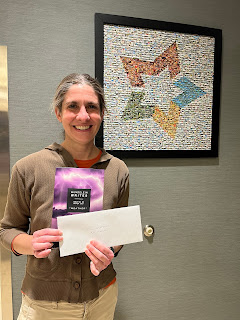
Award Winning!  With the prize and publication.

Not bad for my first short story contest.

It won’t be my last, either.

Here’s the link so you can read my story, “Truck Stop.”


Sunday, September 26, 2021

The Encouraging Blogger Award

I was so honored to be nominated for the Encouraging Blogger Award by Headphonesthoughts.  Every week, Deborah posts a “Thought of the Week” that always inspires me to do my best.  If you want to be encouraged, Headphonesthoughts is one of the best places to start.  The Encouraging Blogger Award was created by Lisa Mitchell of Fluxing Well with the ‘purpose to recognize bloggers who bring encouragement’ with their blogs.

The Rules

The Encouraging Blogger Award was created to recognize any blogger who encourages others with his or her posts. Bloggers may encourage others to travel, try new things, have a positive mindset, or overcome adversity, for example. An encouraging blog may encourage other bloggers or give business tips. Many blogs are encouraging and we don’t even realize it. Bloggers nominate fellow bloggers for this award, and nominees write a post answering a few questions. After that, the nominee nominates other bloggers.

  • When and why did you start blogging?

I started blogging on MySpace about 15 years ago, when I was a traveling consultant spending 75% of the year on the road.  It was a way to pass the time.  My current iteration started when I decided to run the six major marathons in 10 years, hence “6 in 10.”

  • What is your blog about?

My blog started as a running blog to keep me accountable on my marathon training, but has morphed into surviving a global pandemic while coping with Obsessive Compulsive Personality Disorder.  Writing became my therapy, my connection to the outside world.  I believe the power of our own uniqueness, and I’m trying to use my blog to encourage others to embrace theirs.  There is too much of a demand for conformity, especially in a country founded on freedom and choice.

  • What is one piece of advice you would give to encourage new bloggers?

Find your own voice, what makes you exceptional.  It will make you stand out in the endless myriad of blogs.

  • Which is your favorite time-saving blogging tip or scheduling tool?

Use your Notes feature on your phone to jot down ideas if you aren’t in a position to write.  I’ve always got a half-dozen or so ideas floating through my mind, so I always have something to write about.

  • What are your future goals for your blog?

It’s not a blog goal, per se, but to restructure my life so I have more time to create.  I’m just juggling too many things right now to post the amount of content I have amassing in my head.  It would also be nice to grow in readership and see my posts make the world a better place.

I nominate…

Tangela Williams-Spann

The Winter of My Discontent

Unwanted Life

Ruthiee Loves Glamour

Lose Weight With Ang


Thursday, December 31, 2020

The Grind

I’ve been a chemistry tutor for over five years.  What started as helping out a friend has become a new career, and I’ve added math, including calculus, to the mix this year.  Gosh, I so missed solving hard math problems.

Many people think they’re bad at math because they don’t have all the answers instantaneously.  They don’t even know what skill they need to start a problem.  Chemistry is challenging because it’s usually the first time you’re using math to solve science—an entire year of those dreaded word problems.

One of the many secrets to mastering math and chemistry isn’t a formula or a cheat sheet or having mad skills.  It’s being able to attack each problem, each test question.  Look at what you’re given, look at what they want from you, and go from A to B.

How do you do that?  Practice.  The practice of doing many, many problems until you are able to attack anything that might be thrown at you.

It’s no different than anything else you practice—an instrument, a sport, an art.  In order to master any subject, you have to do the grind.  The grind of waking up and doing the same thing day after day.  The grind of focusing on perfecting each little detail.  The grind of continuing to move forward so slowly that you see more failure than success.  The grind of brushing yourself off after each failure and getting back on the path.

Over the years, people are in awe of my chemistry degree, like I have this amazing talent.  To be honest, it’s just that my love of the subject gave me the determination to grind out problem after problem.  I can’t sleep on an unsolved chemistry or math or computer programming problem, often waking at 2 am to finish what I started.  It just tumbles in my brain, crying to be solved, just like the baseball player down the street throwing curveballs at a net late on a summer evening or the oboe player next door playing the same measure of music over and over again on a Saturday morning.

Of course, it’s easy for someone with a passion for baseball or a talent for playing the oboe to do the grind, but have you ever heard someone express a huge passion for being a cog in a Corporate America cube farm?  How do you grind at something you don’t love?  That doesn’t come easily for you?

How many of you loved school when you were in second grade, but hated it by the time you were in high school because the classwork was just so hard?  How many of you grew up playing Little League or taking dance lessons or studying piano, but quit when it seemed that you had hit your limit? 

I joke that I’m the utility ballplayer of life because I’ve done so many things, but quit before I had mastered them.  I’m competent in a lot of skills, but not exceptional.  My resume goes from research chemist to quality consultant to executive director of a political party to tutor.  I’ve taken dance lessons and piano lessons and figure skating lessons.  I played clarinet in the school band, nine years total.  Even where I do have talents, math and science, didn’t help me push through the challenges in college.  I graduated with my degree, but barely.

It’s hard to believe that a year ago, I was on top of the world with my running, having negatively split New York through the hardest part of the course to break 5 hours and get my second fastest time.  2020 was supposed to be the year I took a break from racing to focus on how I could get that Boston qualifying time.  Then the world shut down, and my focus turned to survival.  As the months tickd by, and races continue to be cancelled, delayed, postponed, and modified, I thought about my quest to finish all six majors by my 50th birthday.  The deferments, the cancellations were definitely going to impede my ability to grab slots in Toyko or London once things returned to normal.  There’s usually half a million people who apply for those lotteries in a normal year, but what now?  As for Boston, losing one, if not two years for charity runners will make it even harder to get one of those coveted spots, and I’m so busy trying to survive that running has taken a back seat, derailing my efforts to qualify.

I have five years to get into three major marathons.  I’m barely scraping by, financially, my mental health is a mess, and there are now millions of runners who didn’t get the spots they thought they’d get this year.  How on earth am I going to finish this quest?

Then I thought of my students, past, present, and future.  How many of them feel dumb at school?  How many hate doing homework because they just don’t even understand the lesson?  How many want to give up and say they can’t do chemistry or math?

Tutoring isn’t just about AP exams and letter grades.  It’s about helping these kids overcome challenges, solve problems, and learn how they learn so they can apply these skills for the rest of their life.  Odds are that you won’t have to use the ideal gas law or Rolle’s Theorem in your 40s, but the skills that got you through those assignments and tests, will.

Just like my quest; it is more about the journey more than the end result.

In 2021, I need to figure out how to do the grind when it’s something that isn’t easy or fun or exciting or interesting.  After some soul-searching, I came up with three things I’d like to accomplish this year for three very different reasons.  They are all going to take that grind, though in different ways:

  1. British accent.  As a high school drama kid, I was always jealous of my classmates who could switch into a British accent without even thinking about it.  When I got a part in the fall play and had to do five lines in accent, I spent hours and hours listening to Brits read books on tape, trying to figure out the intonations and pronunciations, but never feeling like I got it right.  Now, with YouTube and Zoom and all sorts of tools (there has to be an app, right?), as well as maturity and wisdom, perhaps I can master something that I was convinced I couldn’t.
  2. Daily routine.  It’s been a year, right?  As I navigated the roller coaster of part time work and furloughs, I saw a lot of my regular maintenance routines falling apart from running to brushing my hair every morning.  I’ve put down the list of things I do want to accomplish every day.  It may not be fun or exciting, but going through the steps to get my life reset will do wonders for my mental health.  (If you were wondering about running, it’s part of this routine.  Baby steps.)
  3. Blogs and Coffee.  As part of my daily routine, I’m reading blogs I find on Twitter over my morning coffee.  I had a great idea a couple of days ago to use the hashtag #blogsandcoffee to share the blogs that I’m reading.  Now, I’ve had a lot of great ideas over the years that get lost on the wayside for a number of reasons, so my goal here is to post #blogsandcoffee every single day in 2021, even if it’s a tweet to say why there wasn’t a #blogsandcoffee.  Maybe it will develop a following, maybe it won’t, but at least I ground through the challenges and finished what I started.

Unlike most New Years resolutions, which have an endpoint, I am creating a focus, an intention, to grow as a person, regardless of whether or not I meet my goals.  If I figure out how to grind through things I don’t enjoy, it’s powerful—and it’s a power I can teach my students so they can succeed, whether it’s third grade math or AP Physics.

Also, rather than a personal, specific goal, it’s a theme we can all take together.  Let’s face it.  2020 was a struggle in many ways.  We survived, but not without damage.  We’re not the same people who started this year, but to continue to thrive, we need to continue to evolve.  We need to grind through our challenges, whether it’s AP Calculus or working from home or figuring out how to change the oil on the car.  What are you needing to grind through in 2021? 

Sunday, November 15, 2020

The Tornado Warning Syndrome

When you grow up in the Midwest, tornado warnings are a part of life.  The hot, humid, sticky day, the darkening skies, the alerts to a tornado watch, and then the sirens, blaring the news that a tornado might be in the area.

My hometown of Crystal Lake, IL, has not seen a significant tornado go through there since 1965.  That tornado was deadly and scary and at a time when the only way meteorologists knew there was a tornado on the ground—was when someone called them and told them a tornado was on the ground.

By the time I was in high school, the idea of a tornado hitting our town, while very possible, seemed very unlikely.  Tornado warnings were still issued primarily by observation and covered a wide area.  Even the worst storms produced funnel clouds, brief touchdowns, or what were ruled later as microbursts, straight line winds.

What we usually get from a tornado warning...do you see any rotation?

Perhaps that’s why, when eating dinner at a Chinese restaurant one summer evening a few years ago, I raced to the window when the tornado warning alerts came over the phone….instead of taking cover.  Peeking through the blinds, I thought, “oh, that’s just a microburst,” rolling my eyes that once again, the National Weather Service got it wrong.

Haha, trust the meteorologists. I can now say I’ve been through a tornado.  Thank goodness it was very, very weak, but as I run around town near the tornado’s path, I can still see the swath of branches that were ripped down by nature’s fury.

I’m in one or two tornado warnings every summer, and yet have only been in one tornado.  Over the course of my lifetime, that means I’m probably 1 for 50—2% chance—of being hit by a tornado when a warning is issued.  With those odds, it’s not a surprise that, when severe weather alerts are issued, people don’t even understand what they mean.  You have no idea now many times I’ve heard, “There’s a tornado watch, which means there’s on the ground.  Well, it’s sunny here, so I’m not taking cover.”  Of course it’s sunny—a tornado watch means conditions are favorable for a tornado to form, so you should be on alert.  The storms are on their way.

I call it the Tornado Warning Syndrome.  You’ve been through so many tornado warnings without actually seeing any significant tornado damage that the warnings are no longer taken seriously, even though tornadoes continue to be a threat.

I’ve been thinking about this mentality as our covid case numbers have been rising exponentially.  When the pandemic began, our governor put the entire state under a stay at home order for two weeks, essentially, a “pandemic” warning.  While we were in a place where only those who needed tests were taking them, the positivity rate was far below 100%.  People were getting sick, but not nearly in the numbers we expected.  Even so, our governor continued to extend the stay at home order for a total of two months, then rolled out a slow reopening plan, based on whether or not spikes would occur.  You could call it a “pandemic watch.”

The problem was that in Chicago, cases were growing exponentially, but even in my little community in the north suburbs, they were trickling.  By the end of the lockdown, early June, less than 200 people had tested positive.  In the rural western and southern parts of the state, the rates were even lower, with many counties having less than a dozen cases.

For the hundreds of thousands of people who not only didn’t know someone who had gotten severely ill, but didn’t know a single person who tested positive, it was just like those tornado warnings of my childhood.  Lots of anxiety and thunder, not a single home destroyed.

The summer continued, positivity rates declined, and people stopped taking the pandemic seriously.  Gatherings that had been postponed started to happen again.  Businesses reopened so they could continue to pay their employees.  People formed “pods” of friends, people who they trusted to stay safe, and continued socializing. 

Like a tornado that can rip a whole house down to the foundation while leaving the next door neighbor intact, outbreaks of covid were occurring, and people were still dying.  However, unless you were connected to an outbreak, the alerts and warnings felt like the tornado warnings with no tornado.  People became increasingly complacent, and businesses tired of struggling for no obvious reason.

As the chilly fall weather approached, people turned inside to gather, and cases started jumping up again.  The pleas to stay at home were falling on deaf ears, as families wanted to see each other, friends wanted to celebrate, and people craved social contact.  As the governor tried to stop the spread by restricting indoor dining, restaurant owners fought back, citing that not a single one of their employees had tested positive for Covid, so they were being unfairly punished when the actual outbreaks were tied to private gatherings where protocols were not being followed. 

When a storm system produces a large number of tornadoes, ironically, it is called an outbreak.  Well, we have an outbreak of Covid—a SuperOutbreak, even—but will people heed the warnings as hospitals and ICU beds fill?  Or will they feel like they’ve been told the sky is falling for so long that they’ll just ignore the warnings?

Don’t be fooled.  I’ll never forget my senior year first semester final exams.  It was January, and of course, a snowstorm was headed to Chicago.  The forecasters, based in Chicago, didn’t think it would be a significant snowfall, and so my district didn’t plan to cancel school (because, first day of finals).  Being so far from the city changed the forecast drastically.  While Chicago proper had a typical snowy January day, we ended up having to traverse heavy snow—the final storm total was over a foot—to get to school in time to take our finals.  The buses were having so much trouble that the school had to adjust the entire day by 20 minutes so everyone had the full time for their exam.

Just because you don’t see the havoc that these skyrocketing numbers are making doesn’t mean you’re not in danger.  Just like our school, watching the Chicago media, was caught unaware of a narrow, heavy snow band, don’t think that just because you don’t know someone with Covid means you have no risk.

Stay home.  Wear your mask.  Wash your hands.  Be safe.  Be well.  And don’t fall for Tornado Warning Syndrome.

Monday, October 26, 2020

Of Avengers and Presidents

Fall…is just the worst time of year for me.  Not only is the world losing the warmth and green and sun of summer, but September is the anniversary of my two longest relationships ending.  Just looking out the window at grey skies, seeing the dead leaves swirl in the chilly wind, makes me feel all the sadness in the world. 

September is also the anniversary of the passing of a college classmate, killed while training for the Chicago Marathon in 2003.  Even the excitement and happiness of fall marathon season is twinged with sadness of what could have been for him, and I find myself thinking about Scott a lot during the “taper tantrum,” the last few weeks of training where you rest your body before Marathon Sunday.

Cue in…escapism via Hollywood.  Without the usual distractions of marathons this year, I found myself coping by catching up on the entire Marvel Cinematic Universe.  As self-care, it was perfect mind-numbing fun, and hey, I might as well get the most out of my free trial of Disney+ before it ends, right?

The one thing I noticed throughout the movies is that, outside of the plot to assassinate the President in Iron Man 3, the President of the United States is a non-entity, to the point that only Iron Man 3 is the only time an actor portrays the President.  Congressmen, United Nations, Cabinet members, military officials, but no President.  The Winter Soldier is a political thriller where the President is completely irrelevant, relegated to a name on the wall in a Smithsonian exhibit. 

Shouldn’t Tony Stark have the President on speed dial?

Obviously, it’s Hollywood, and especially when you have something like 25 Avengers and who knows how many side characters in the last two films, there’s just not time—or plot—to include any sort of normal governmental response to events.  However, watching these films on the eve of a Presidential election, the lack of a President in 22 of the 23 MCU films stands out—and has me reflecting on the role of the President as defined in the Constitution.

The whole point of the President was for him (or her) not to become a dictator or a monarch.  He or she only carries one third of the power, sharing with the Supreme Court and Congress.  You can even argue, with their power to create laws and distribute funds, that Congress, a body of normal citizens elected by normal citizens, has slightly more power than the other two branches.  Rather than being led by one person, we are led by 545.  (President + Supreme Court + Congress)

In addition, the President is given a Cabinet of department Secretaries, who help manage the Executive Branch.  While the President appoints those Secretaries, these appointments are confirmed by the Senate.  While the President, often through the Secretary of State, negotiates treaties, they are not valid until the Senate approves them.  It’s no surprise that the Avengers, when it comes to the Sokovia Accords, have to deal with a Secretary of State confirmed by the Senate, rather than the President directly.

The tweets and posts and grams and snaps (as in chat, not Gauntlet) about our Presidential election tell a very different story.  There seems to be this mythos within the American people that the US President is the most powerful person in the world, a modern-day Queen Victoria, who can do anything they want with a sign of the pen.  My social media feeds oscillate between posts describing how a candidate can fix every problem in our country to how a candidate will rule by fiat if elected. 

The importance and weight we have put on electing a President is not unusual.  Since President Trump was elected, however, the amount of energy that has been given to every single Tweet or speech or action has been elevated.  The fear that the President can do whatever he wants, the anger and rage when the President does something undesirable, and the anger and rage of the people who are tired of the former’s anger and rage—it’s a constant stream of energy and attention.  However, nobody considers how all that energy is feeding the beast, inadvertently growing the power of someone who shouldn’t have all that much.  Perhaps I’ve just invented the next Marvel villain, a politician who feeds off of social media drama to the point of developing superpowers…

Seriously, people.  The Democratic Party has control of the US House, leaving the US Senate stuck between the President and the House.  (You want to know why Majority Leader Mitch McConnell is so wishy-washy?  He’s literally stuck between a rock and a hard place.)  The Supreme Court, even Trump’s own nominees, have shown independence in their decisions, continuing the history of taking each case as it is and comparing to the Constitution, rather than blindly following the President who appointed them.  The checks and balances are in place.  Our Constitution is working.  So why do so many Americans fear a President who can only have 30% of the power, and therefore, cannot do half of what he claims he can?

More importantly, why are you giving a man who clearly feeds off this negative attention so much brainspace in your life?

The President is not Thanos.  The President is….the President, limited by the Constitution.

So take a piece of wisdom from the MCU and stop putting so much energy into our President.  The entire House of Representatives is up for re-election.  One third of the Senate as well.  Local officials, who have a greater ability to fix the problems in your community are up for re-election as well.  All people who help limit the power of the person in the White House.

Voting, 2020 style...to be honest, I was there to help Mike Nerheim and Howard Cooper get re-elected as State's Attorney and Cororner more than I was interested in casting a vote for President.

That is, after all, what our Founding Fathers intended.  Who knew that the Avengers would be so wise in Constitutional law, paying attention to the people who actually held the power?

Monday, September 21, 2020

You. Yes, YOU can Stop Election Fraud

I’ve seen a lot of hand-wringing about election fraud, from my Facebook friends to Presidential candidates.  Things like ballots being in trunks of cars to dead people voting are no longer jokes.  From my experience as a political operative, most of these stories of fraud come down to incompetence, whether on the part of the voters, the officials running the election, or even the local party offices.  While in most cases these incidents involve such a minority of votes being cast that they only impact the local and regional elections, we all saw in 2000 that they can—and do—affect our national elections.    

However, there is a solution.  The way to stop election fraud is to reduce the amount of incompetence in the system….and that is actually easier to do than you think.  In the days of smartphones and social media, the information is at the tip of your fingers, so here are three things you can do to help fight election fraud:

  1. Know your laws.  While the federal government makes overarching rules about elections, the details of the mechanics of voting are left to the individual states.  State statute determines the rules about polling places, electioneering, mail in voting, and so forth.  One common “disenfranchisement” I’ve seen in Illinois is that if you apply to vote by mail and still come to the polls, you have to vote “provisionally,” meaning that your vote cannot be counted until it is determined that you did not vote your mail-in ballot, usually two weeks after the election.  Said that way, it makes a lot of sense—they can’t count your ballot until they know you haven’t voted twice—but since the law allows political parties, assisted living community activity directors, and other third party organizations to facilitate mail-in ballot requests, people often don’t realize the thing they sent to the Tenth Dems or the Lake County Republicans was actually a mail in ballot request and think what they got back was a sample ballot from the party.  Fast forward to Election Day, and the only thing the election judge knows is that you already are holding a ballot, so they cannot allow you to vote normally.  With so many vote by mail applications going around this year, it’s a great example of a detail you should learn and tell others.
  2. Downticket matters.  While the state legislatures create the laws concerning elections, the actual operation of managing the election falls to local officials.  They can be an elected county clerk, like I have, a commission of people appointed by the county board, or even an elected judge.  Many people don’t know any of these names on the ballot and just vote by party, often electing people who have little to no experience managing an election or even a basic understanding of election law.  If there’s one office on your ballot that is worth taking the time to research, it’s that one, and if I could do it using dial-up in my hotel room 15 years ago, there’s really no excuse for not doing it today.  These offices rarely the resources needed to put a full campaign together, so we can all use social media to help exceptional, competent, unbiased leaders are the ones managing our elections.
  3. Be part of the process.  Did you know you can help manage your local election?  Election judges are citizens just like you who have been trained to enforce election law and ensure smooth voting processes for all.  In my area, the election judges tend to be retirees who aren’t working, but since they are high risk for covid, the need is greater than ever.  Don’t have the time to commit to being an election judge?  You can also be a poll watcher, a trained volunteer observer that sits in the polling place and monitors if election law is being followed.  Both political parties use poll watchers to observe what is going on in specific polling places, and there are non-partisan groups who use poll watchers to ensure a fair election.    

If you think it’s too time consuming and complicated to make a difference, note that Russia and China do as well.  The sheer amount of resources and coordination needed to change a national election result would not escape notice from the multitude of local election officials, especially in a country where local elected officials have the freedom to speak their mind.  As do the media, from the talking heads to the local reporters.  Even the much-maligned Electoral College acts as a deterrent because anyone trying to interfere with our election would have to operate in multiple states, rather than just focusing on upping the vote total in one populous state.  An organized, Mission: Impossible, type operation is truly impossible.

However, when elections are decided by voters who spend more time focused on celebrities and the British Royal family than the happenings in Congress, the misleading ads and the flat-out false mailers are able to change election results.  It’s not isolated to the Presidential race, either.  Actually, since people don’t even know their local candidates, voters are easily mislead by negative ads and mailers designed to push buttons instead of inform.  Not only do these candidates have websites and social media channels, but they take the time to fill out endorsement questionnaires from the local newspapers, giving us the resources to become educated voters and to help educate others.  I mean, should we really be deciding our judges, our coroners, our county clerks based on who is running for President, or should we be picking the best qualified officials with no regard to party affiliation?

My local grocery store checkout line, filled with celebrities and tabloids, but we don't have time to research local candidates....


How will I be preventing election fraud?  I’ll be voting early in person this year.  If there are any issues, it will still be before the deadline to request a mail-in ballot.  Why not a mail-in ballot?  My state uses signature verification to verify voters, and since I registered to vote in 2004, my signature has changed quite a bit.  After my horrible experience voting in the primary, I don’t trust my county clerk’s office to verify my signature correctly, so I want to make sure I’m present for that verification.  It’s a simple way to ensure that my vote will count, because I’m educated in how our election is supposed to work.  I may even volunteer as a poll watcher this fall if I have the time to make sure other voters are given proper treatment. 

Always displaying my "I Voted" stickers!

Now that you know what you can do, what will you do to stop election fraud?  Will you endorse a local candidate?  Will you post the website from your local election authority?  Will you work as an election judge or a pollwatcher?  If every one of us did one little thing, we can combat election fraud.

Tuesday, August 25, 2020

Paradigms, Masks, and All the Anger from Paradigms and Masks

My freshman year of college, I had to read a book called The Structure of Scientific Revolutions by Thomas Kuhn.  It blew my mind.  I was the science loving kid who talked in her college essays of the random science experiments she did with her makeup set when she was 5 and the hours spent watching clouds pass overhead, her inner meteorologist wishing for a storm.  Science was truth.  Facts.  Unbiased.  Solid.

Kuhn, a University of Chicago professor, had a different idea.  Ever hear the term, “paradigm shift?”  That was his idea.  What we think today about science can change, based on new information and data.  When he wrote it in the early 1960s, it took off enough that “paradigm shift” entered the modern vernacular, but his second idea didn’t.  It was that science is a series of paradigm shifts that take us closer to the truth. 

I loved it.  Whether looking at Galileo and Newton or the science section of the Sunday newspaper, every discovery, small or large, shifted the paradigm.  The study of facts and laws had become a journey of problem solving to get closer to the truth.

It was the start of four years where science wasn’t the study of facts but the study of what truth could be.  Classes where I manipulated virus DNA and played with organic dyes, and a senior year studying the paleoclimatology of the Lake Winnebago region of Wisconsin for an attempt at an honors thesis I was just too exhausted by May to finish.  In that process, I learned the journey toward the truth wasn’t always easy or kind or simple.

Fast forward to this January, as I started hearing about a novel coronavirus appearing in Wuhan, China.  Having a friend living there, I followed the story fairly closely as it traveled to Europe and Kirkland, WA, and New York City.  Suddenly, the paradigms that had served the CDC well during SARS and MERS and H1N1 didn’t work, and we were plunged into lockdown, with everything closed except the essentials. 

Kuhn, it seems, served me well.  I understood that we were in a situation with so many unknowns—so many variables—that we were far from the truth, and as such, were in for a roller coaster of paradigm shifts.  I expected changes and conflicting information as the scientists worked tirelessly to get closer and closer to the truth.

Which comes to masks.  With so little known about what would be called Covid-19 (or Covid for short), the question became, “Will wearing a mask prevent getting sick?”  At first, scientists didn’t know how Covid was spread.  Was it droplet?  Was it surfaces?  Was it close contact?  How close?  Plus, the largest producer of N95 masks, the ones being used in hospitals, was Wuhan, China, the epicenter of the Covid pandemic, so there were serious concerns about shortages from panic buying on an item that was critical for those treating Covid patients.  The official recommendation back in March was “No.”

Everyone accepted what the scientists were saying back in March as truth and made do with our new normal, but then the paradigm shifted.  What was true in March wasn’t true in May, including that the scientists learned that transmission was through droplets, so wearing a mask, especially in interior, confined spaces, would reduce infections.  The CDC shifted their recommendation, governments started to put in mask mandates, and citizens…scratched their heads at what they saw was an about-face.

Let’s not forget that masks are hot and uncomfortable, especially in the heat of summer.  People feel so suffocated that I see someone every day who is pulling off their mask every minute or so to breathe. 

While one population was struggling with wearing masks, another group of people were keeping on top of each and every news story about the virus.  These people were scared—even terrified—of getting sick and ending up in the ICU with Covid.  Whether they were high risk due to medical conditions, knew someone who had gotten sick, or just saw the reports from Italy and NYC, their fears were real and valid, and even one person dying of Covid was one too many, because it could be them next.

When the paradigm about masks changed, they breathed a sigh of relief, something that was visual and tactile to alleviate their fears.  If everyone wore masks, they don’t have to be scared.

However, there was more than the mask paradigm shift.  We were learning a lot about the little balls of protein that had taken our country hostage.  They didn’t live on surfaces.  It was actually safe to go to the grocery store (provided that you wear a mask).  You needed to be within 6 feet of someone for more than 15 minutes without wearing a mask to risk being exposed.  Being outside was safer than being inside.  Doctors in hospitals were learning better ways of treating patients so they didn’t require ventilators.  We got smarter in how we protected our most high risk, vulnerable populations.  The refrigerated trucks were no longer needed.  The makeshift hospitals were taken down. 

Covid, it seemed, wasn’t the black death we thought it would be in April, as long as we continued to wear masks.  The people reading every news story, struggling to make sense of it all, couldn’t.  There were too many shifts, too many changes….and we were still very far from the truth. 

We forget how few people in this country haven’t taken a formal science class in decades, probably in high school or to fulfill a requirement in college.  Even then, those are classes focused on teaching the basics, which don’t change much year to year.  When I started tutoring chemistry, I was concerned how much had changed since the 1990s.  At the high school level, not much, and for the most part, are things that they were predicting were true 30 years ago.

We also forget that for a lot of people, getting through those classes was a challenge.  I’ll never forget my chemistry teacher first introducing the concept of the mole my sophomore year in high school.  I saw classmates’ eyes glaze over in confusion, and some of them struggled for the rest of the year.  Even now, when I tell people I have a degree in chemistry, people respond with appreciation because high school chemistry was just that hard for them.

It was too much to understand why a hot, uncomfortable mask was necessary when nobody they knew had gotten sick.  It was too much to understand why people couldn’t take the illness that brought New York City to its knees just a few months ago seriously.  In this heated, divided environment we call the United States of America, the anger simmered over.

From angry posts on social media to protests about government overreach to actual confrontations in stores, people scared—of government overreach, of dying, of getting sick—lashed out in anger, creating more fear, more defensive behavior, and more doubling down on the divide.  We find the sources of information, the articles, the facts that support our viewpoint, and pontificate to the masses, accusing each other of “not believing in science.”

I hate to be the bearer of bad news, but science isn’t black and white, or right and wrong.  When it’s something new and unknown, it’s fluid, and it will take a long time to figure out the truth.  It took scientists until World War II to figure out that the influenza virus that caused the 1918 pandemic….was caused by a virus.  Like, they were trying to save people’s lives and couldn’t agree whether it was a bacterium or a virus. 

We may be faster now, but we are still many, many paradigm shifts before the science of covid is part of the hard facts in a high school biology textbook and we’re back to our pre-covid lives.  For me, “believing in science” is believing that until we get to the truth, science will be filled with unknowns, conflicting information, and change, something very different than what we learned in high school.

I know it’s scary, but it’s time to ride the wave of paradigm shifts, being okay with what is truth now and being okay with when it shifts.  Even if it doesn’t make sense, it will soon, and sooner if we all start working together instead of against each other.  Starting with…..be nice, be kind, and wear your mask.

 Pink bandanas make everyone happy

(Oh, and if you want a great mask that does good in the world, check out 2 Little Mask Makers.  Custom masks for $5, which goes to the Northern Illinois Food Bank and local school districts in need.)
Wednesday, August 12, 2020

Why Can’t We All Just Get Along?

We all agree.  It’s been a rough year for the United States.  Americans are stressed and frustrated….and angry.

From politics to masks to the politics of mask-wearing, social media is filled with angry rants.  Rants that, at the end of the day, are just one form or another of “Listen to me!  Agree with me!  I’m right!”

It’s like we have become a real-life version of the Dr. Seuss book, The Sneetches.

Masks, Covid, Presidential candidates, and everything else has a “you’re either with me or against me” mentality.  Either you agree with me 100%, or you are evil.  No middle ground.  No compassion.  No empathy.

Remember the guy in the Sneetches with the Star-On and Star-Off machines?  He manipulated the division to become a very wealthy man.  Same is true today, as people on both sides capitalize on the partisanship for wealth and power and glory.

"The Sneetches" was originally published in Redbook in 1953.  Yet, so little has changed.

We have forgotten that our nation….was founded on dissent.  We fought a war to have the freedom to oppose the King.  We wrote a Constitution that gave a legislative body of elected citizens equal power to the President.  We amended that constitution to guarantee freedom of speech.  We also spelled out that the states had the power to organize and govern independently of each other.

Of course, we think this all happened in a room full of men wearing powdered wigs congratulating each other.  However, as a college classmate reminded me, the arguments that created the Constitution were probably just as heated and foul-mouthed as the ones on Capitol Hill today.

I’m fortunate to have worked hard through high school so I had the opportunity to attend a college where dissent was part of the culture.  Listen to dissent.  Challenge it.  Defend it.  Change your mind.  Respect that not everyone is going to agree with you 100%.  That, my friends, is critical thinking. 

In order to critically think, you have to be able to listen to people who disagree with you.  You have to respect people who disagree with you.  And that’s not happening.  Instead, I see people building bubbles of people who look like them, think like them, and act like them.  They’ll embrace someone who might be different, but only as long as they fit the checklist.

You thought Mean Girls was only about teenagers…..our country is filled with cliques.

Maybe because my brain functions so differently than normal, I can’t fit in those bubbles.  I don’t have a lot of true, close, real friends.  I can’t even have a normal conversation with my family.  But that crazy brain also allows me to have wonderful, insightful, interesting conversations with people who don’t look like me or think like me or act like me.  Due to those experiences, I have something important to say:

*grabs bullhorn*

If you’re too busy demanding that people listen to you and agree with you, you’re missing out on what makes this country so wonderful.

One of the “silver linings” of the pandemic is that I’ve gotten to know my neighbors, now that we’re all at home more and walking around the neighborhood.  I had no idea how beautifully diverse my neighborhood is.  Yes, beautifully.  Since we’re sort of stuck at home, we’re out of our houses, having the conversations we need to have to strengthen our community, because we’re all part of this community.

You see, the power of our country is our diversity.  Whether it’s a diversity of genetics or a diversity of ideas, what makes the US a superpower is that we validate everyone equally.  It’s not perfect or a sunny utopia, but as we hit rough roads, we grow and change and evolve.  (Though in some cases, not as fast as we should.)

Do you watch the Olympics?  I’ve been watching the Opening Ceremonies for decades.  It’s always fun when the USA is at the end of the Parade of Nations, because we spend an hour watching the rest of the world walk in, homogeneous, formal….and then there’s USA.  All colors of the rainbow, all backgrounds, all states, just dancing and filming and waving the stars and stripes.  Unified within our diversity, and in that, being one of the most successful nations in terms of medal haul, even as other countries cheat to compete with us.  It’s one example of how diversity makes our country great.

For us to get through 2020, we need to stop sticking our fingers in our ears while screaming “I’m right” at the top of our lungs.  We need to take a breath and show a little empathy for our fellow citizens.  We need to listen, honestly listen, to understand why they disagree with us.  You can be empathic without changing your viewpoint, you know.  You might even find out that you agree on a few things.  We need to go outside our circles, our communities, to try new things and experiences—because they’re interesting, not because they’re trendy or that’s what the celebrities on social media are doing.

(I know the partisans will hit his point and point fingers at the other side.  You can start by treating politics more like a policy debate and less like a Bears/Packer playoff game.  I mean, how do you want to be seen?  A thoughtful intellectual or a drunk tailgater?)

You see, once we open ourselves to those who are different, we gain the confidence to go outside the norms and be different.  We start seeing the world through other people’s eyes—yes, empathy—and we see the creativity and innovation that is inside all of us, the creativity and innovation that might solve one of our country’s many problems, and right now, we need to support that creativity and innovation, rather than squelching it, simply because we are afraid of being “wrong.”

The truth is that in a country of 330 million people and a Constitution that guarantees freedom of belief…there are 330 million belief systems in this country.  There is no “right” or “wrong.”  There is just being and living and growing and respecting and accepting and encouraging and innovating to a place where we continue to be the superpower we are.

So stop making people fit in your box.  Stop making yourself fit into other people’s boxes.  Be you.  Be nice.  Be kind.  Respect your fellow citizens.  Encourage all forms of diversity, especially within yourself.

We’ll get through this, everyone.  Together.

Sunday, July 19, 2020

The Face in the Jar by the Door

Before I quit skating back in 2011, I had decided my next freestyle program was going to be to Eleanor Rigby. 


Eleanor Rigby

Picks up the rice in the church where a wedding has been

Lives in a dream

Waits at the window

Wearing the face that she keeps in a jar by the door

Who is it for?

I have lived my entire adult life wearing the face I keep in a jar by the door. 

It’s understandable, given my childhood.  I was not an easy child for any mother, between the OCD and the high IQ, but my mother came into parenting with the scars of her own difficult childhood.  Today, she probably would have known to heal herself before becoming a parent, but back then, she saw being a wife and mother as her salvation.

She had no idea what to do with a kid who just saw the world so differently than everyone else.  A kid who taught herself how to read and do multiplication, but would get insanely frustrated if things weren’t exactly ordered in her head.  (For example, I nearly had a meltdown on the first day of kindergarten….because the school bus didn’t have seatbelts.  In 1979, when you could drive around in your car without wearing a seatbelt.)

Overwhelmed by the meltdowns and scared of what the world would do to her outlier child, she did what she learned from growing up in an alcoholic family.  Pretend.  She would say things to me like, “you know, you’re not going to have any friends if you act this way.”  “Do you know how difficult you are to live with?”  In eighth grade, I’d have to come home from school, detail every social interaction, and problem solve to see how I could do better.  Every day.

She was determined to jam my square peg into that round hole, even if my self-esteem was destroyed in the process.  Her anxiety over me was so great that she would do whatever it took to gain total control of my life, even into adulthood.

Instead of creating a confident young woman who glided through social interactions, she created a woman who felt the need to pretend to be someone else to garner acceptance.  I created my face in the jar and learned how to navigate life wearing it.  My mother loved “Face in the Jar” Erin better than the person I really was.  At one point, after a sorority Mother’s Day tea, said to me, “why can’t you be like this all the time?”  Because, Mom, it’s an act.  It’s not me.

In the process of healing from the breakup of a four-year relationship, I’ve been reflecting on connection and my connection to the world.  That face in the jar has allowed me to navigate the adult world, but I don’t feel connected to it in any way, shape or form.  I have friends, but not a single best friend who gets me on that deeper level, because it’s hard to let anyone in.  Don’t even get me started about dating, which is all about putting your best foot forward while having a good time….until it’s time to take down the façade and be vulnerable with each other.  My ex once got angry at me because I didn’t trust him.  He was absolutely right, but it never occurred to both of us that perhaps we should have stepped back from our relationship and worked on building that trust.  Instead, he decided that because I didn’t trust him, he had carte blanche to treat me however he wanted.

And that’s the thing about my face in the jar.  It’s a laid back, amenable person who has allowed herself to be stepped on, walked over, or in the case of my ex, steamrolled.  It’s someone who is easy to ignore or fade into the background.  It’s someone who never complains or creates drama for others.  It’s someone who is easily forgotten, someone who knows how to be invisible.  Someone completely different than the woman whose mind is always on overdrive with thoughts, ideas, and keeping ahead of her OCD.

One of the things that has been tumbling in my mind of late is whether it’s time to leave the face in the jar when I leave the house.  Then I look at the world right now and see all the the anger and vitriol and judgement and closemindedness and intolerance towards each other.  It saddens me that as a culture, we are so dogmatic about receiving conformation about our own beliefs that we have zero respect for someone who disagrees with them.  We are supposed to be a country where each of the 330 million people get to believe whatever they want, but instead, I see a country where if you don’t conform 100% to whatever, you are automatically horse manure…and I’m scared of how I’ll be treated if I didn’t wear my face in the jar.

Eleanor Rigby resonates because so many of us keep faces in jars by our doors, afraid of what would happen if people saw our true selves.  We’re supposed to be the champions of individuality, but instead we force people into silent conformity.  To fix our country, we need to start here, and it’s why I no longer want to hide. 


Sunday, January 22, 2017

Quest, Derailed

Yes, it’s been a year.

When I started this quest, I had planned to work on my blog every Sunday, then I met a cute guy and then we started doing Sunday Funday and then it was harder and harder to find time to do the blogs and….

But I was still running.  I was still improving, still moving towards the goal of the six marathons.  The blog was just to keep me accountable, and since I was progressing, there was no need to dedicate serious time for the blog, a good thing because it seemed that I didn’t have a lot of time and energy for it.

I was helping a friend (and working on my time) by helping a friend train for a marathon.  I worked out with the Libertyville Running Club and ended up running a 7:35 mile at the final time trial.  I entered both the Toyko and London marathon lotteries (but didn’t get in) and helped out on my charity team’s committee, hoping I can get a charity bib into New York.  The quest was progressing forward, and I didn’t need to be held accountable.

At the same time, there were subtle dynamics going on around me that I couldn’t ignore.  While everyone was super-nice with the run club, it did feel like a closer circle was forming, and typical of my life, I didn’t know what I did or didn’t do to be excluded from this circle.  I couldn’t be that upset, since 1.  I couldn’t afford to keep up with them because I have to save money for the marathons 2. My life was full and busy without them and 3. I was too shy to put any effort into connections.  However, the change in the energy affected my enthusiasm for the club. 

Then we had a little election.  For 99% of the country, they are armchair politicos, watching on news and posting on social media, but really have not invested any effort to impact the outcome.  However, my boyfriend and I work in the political field, so our lives can be dramatically affected by the vote.  In a Presidential year, it’s especially nerve wracking because so many voters chose their President and vote downticket that our lives are impacted by people who don’t even know what they are doing.
This election was contentious and emotional and angry, and in the end, the national election was the complete opposite of our local results.  While you can’t make politics personal—we are professionals, after all—there is a letdown, almost a grieving process, after an election.  Usually, most people go back their jobs, their lives, just as they are, pre-election, except for that 1%, like my boyfriend and I, whose lives were dramatically changed by the results.

This year, however, was different.  Many people were upset about the election results, including many in the run club.  Not only did I represent the other side, but I couldn’t help but wonder how many helped to turn my life upside down because they didn't see below the top of the ticket.  I was already feeling a little out of place before this happened, but now I felt isolated and unwelcome, to the point that I questioned why we were even doing this quest.


It was an extremely generous gift to have found my friend Christy, then.  She saw me through all this difficulty, running mile after mile and understanding my feelings.  And at my lowest point, she gave me a very special gift—a birthday marathon in New Orleans, LA.  It brought me back to running—and eventually, back to my run club.  However, my life is still very much in flux, to the point that I can’t make major financial decisions.  Consider it a setback in my quest.  We’ll be up and running and fighting again, but for now, it’s all about qualifying for Boston and writing blog posts, because that’s all I can afford to do.

Thursday, June 9, 2016

Wait, wasn’t this blog supposed to keep me accountable? (Year 2 of the Quest)

A few months ago, the leader of our run club asked if anyone had a blog because he wants to publicize them on the club website.

I started this blog to keep me accountable on my goal—six major marathons in ten years—but life has a funny way about happening while you try to make plans.  When I started this blog, my personal paradigm was that life in my forties was going to be about work and running and my cat.  The guy I had a crush on probably didn’t know I was alive, anyway….

Well, he found me.  The day before my birthday he asked me to lunch, and about a month later, I accepted.  At that lunch, he asked me to a concert, and to my surprise, actually followed through.  It was probably the most nerve-wracking first date of my life, but by summer, we had dedicated Sunday—the day I was supposed to write my blog post—as our day to be together.  Of course, when you have an amazing man, why on earth would you say, “um, no, I have to write a blog post” when he wants to spend the day with you?

So my day dedicated for blogging was filled with adventures.  Concerts and ice skating, botanic gardens and even running, days filled with fun and love.  One of the things that we have in common is college cross country, so he started running with my run club, as well as with me. 

Summer changed into fall, and he decided that he would join me in Las Vegas, running his first half marathon.  More of my time was being spent training for Chicago, but he was racking up the miles, too, preparing for Vegas.  He was my biggest cheerleader in Chicago, and after finishing a tough race, patiently waited for me to finish Vegas.

As I entered Year 2 of this journey, it was clear that I just purely didn’t have time to keep up with a weekly blog.  However, I have been running.  A lot.  With an unpredictable work schedule, I decided to save my race money for my three international marathons and train like crazy to get closer to BQ pace.  Meaning, my goal is in mileage—2016, to be exact—rather than in races.

Trying to stay on pace of this goal in winter was tough.  The cold, the dark, my work schedule, time with the boyfriend, even keeping running clothes clean were all challenges.  Even with having running friends and a great club, I have fallen behind pace quite a bit.  The blog, behind even more.
I had to step back and consider why I am writing the blog in the first place.  The goal is to hold me accountable towards my quest.  Well, I signed up for the London lottery last week.  I also started to put together the framework for being a charity runner at the NYC marathon next year.  I’m slowly knocking seconds off my runs, inching closer to Boston qualification, and really utilizing the power of positive thinking (from myself and my running club) to believe it is possible.  I even shocked myself and did a 7:55 mile last week, only 49 seconds slower than my high school PR, set when I was 15.

However, I’m still lagging a bit behind pace to do 2016 miles in 2016.  Quite a bit.  (Did you see the last post?  I’m stuck in April!)  The cold temperatures and the short days made it difficult to get out the door and run.  The days have gotten longer and the weather warmer, so I’m thinking it’s time to get streaky…


Um, not this streak...

Until I catch up a bit on the mileage, I’m going to try to grab some miles every day.  It’s a challenge because I’m 41, and rest is very important to prevent injury, so walks are included in this mileage grab, even walks that are a normal part of my life.  I also have to remember (again!) that I’m on a quest, and that the journey is significantly more important than any destination—or any goal.

It’s time to get faster, crush some serious mileage, and streak!!!  Ethel, cover your eyes!

Monday, June 6, 2016

#KiloMay

My running club, the Libertyville Running Club, is never dull.  It is full of fun, creative people, which leads to a lot of silly inside jokes and crazy spontaneous events.

(For starters, Jill and Trisha write these entertaining blogs about running and life.  I call this my Serious Journal in contrast.)

When our leader went out of town to run a marathon (again), he left the club in the hands of one of his friends and regular runners.  Jeremy was left to do the map…and accidentally ended up writing it in kilometers instead of miles.  He corrected the map, but after he posted it on the Facebook group—and several people, including our fearless leader, noticed.  With it being the last day of April, at a point where most of the club was between marathon training plans, KiloMay, the celebration of kilometers in the month of May, was born.

(He’s left me in charge a couple of times to lead runs.  The first time, it started to thunder, and I just said, “don’t get hit by lightning.”  Why he trusts me to do anything, I have no idea.) 

Of course, the next step was to switch our Strava accounts to kilometers.  It’s been an interesting adventure to try to keep clicking the seconds off the mileage pace when you have to convert your mileage to…kilometerage?  Kilos? 

Another aspect of running a bit blind is that I’ve been tracking how I’ve been doing with 2016 miles in 2016 using a calendar.  6 miles a day is about 10 kilos, but how does this translate?  How many miles have I done this month?  Am I on pace or have I fallen behind? 


Okay, yes, I'm woefully beyond pace...but I marathon train in the summer.


It has been a fun change of pace, as well as keeping myself from overdoing things.  You can’t stress about pace or mileage when you are running a bit blind.  However, let me say how glad I am that it is June, that I’m back to mileage, and pushing forward towards my 2016 miles in 2016…

Saturday, February 20, 2016

Training Miles are Not the Same as Race Miles, but so Important

A couple weeks ago, what I thought would be an easy Saturday long run was unexpectedly exhausting and slow.  Since Fat Tuesday was that week, we were doing a new route so we could visit a Polish deli and eat paczkis.  Given that the total mileage was lower than previous weeks, and the weather was unseasonably warm, I was excited to do the run. 

As always, the first few miles are the easiest, since everyone was running together and generally chatty.  We got to the first water stop, about 2.5 miles in, and I realized that I would be running the rest of the 13 by myself; most of the people at my pace were turning around, done for the day.
After taking some of our much appreciated club Gatorade, I pushed forward, surprised at the chill and wind in the air.  Even though the sun had come over the horizon, the wind kept blowing every bit of heat I could generate away.  I just plowed on, back to the water stop, where I discovered the deli was closed until 9 am.  No matter to me, because it was just about accruing mileage.  The paczkis were just a bonus.

I had a long time to think as I plodded along, and the one thing that kept going through my mind was that training miles are so much harder than race miles.  It’s not something that is talked about much, but a race is the culmination of the training.  Even in high school and college, where we raced every weekend, the goal was to peak at conference or Regionals or Sectionals or State or Nationals.  If you prepared all year, that last race was a breeze.  If not, it was the end of a difficult season.

All of my marathons have been challenging, despite being mostly prepared for all of them.  I can’t possibly imagine what it would be like to not be prepared for that effort.  Even so, I hear people talk in corrals about being less than prepared and read blogs about people who struggled to find the time to do that last long training run.  Why?  Because training for a race is nothing like that cute montage in the movies.  When you’re a 12 min marathoner, running a marathon is an all-day event, so doing those long training runs can be an all-day event.  It’s long and slow and boring and tiring, and in this “shiny object” sort of world, it’s so much easier to fill one’s time with fun instead of boring.  Perhaps, though, my marathon experiences make me appreciate all those training runs because I’m not needing a race to motivate me.

On today’s run, I was talking with a friend about training.  I have learned by watching successful figure skaters (even in the “recreational” adult ranks) that to get results, you truly have to treat training like a part time job.  Training has to be a priority in your schedule, as does recovery, and sessions need to be organized in a way to balance with the rest of life.  In addition, making sure to get enough sleep at night and to eat a healthy diet are key components as well.

Last night I was frustrated over having to do 14 miles because it was going to take all morning to complete.  It would be so nice to be faster, to not have to schedule all day for a long training run.  How quickly I have forgotten that “fast” and “slow” are relative terms, and that no matter what pace, a long training run can be difficult and boring.  (And often, a faster runner just adds miles to the run rather than make it shorter.)


Epilogue:  I spent the entire next week sick with a bug, so I’m guessing it was why the paczki run was so tough.  I’m falling a bit behind with mileage in February so hopefully the weather will warm up and I’ll be able to add some miles in soon!

Saturday, October 10, 2015

Rivalries and Nerves (Marathon Training, Week 18)

Six days before my first marathon in the quest, and nervous wreck.  Why?  A rivalry.
Now, I love friendly rivalries, the ones that push both of us to do our best and come from a place of friendship and caring.  It encourages me to be a better runner and person.  But there are also times where my Type A competitive nature gets the best of me. 

There’s a girl in the area who when I switched back to running, tried to take me “under her wing.”  While I appreciated her insight, she didn’t seem to understand that my goals and attitudes about running were very different.  I’ve been doing this competitive athlete thing a very long time.  I’ve been the kid too slow to make the varsity team when the team qualified for the state finals, and I’ve been the adult skater who was in first place at Adult Nationals.  I’ve weathered through illness and injury, but I’ve also struggled with motivation and confidence.  If there’s one thing I’ve learned, it’s that your passion has to be in the process of training.

When we first met, I assumed, based on her constant signing up for races, that she was just as passionate about going out and running.  Nope.  She really didn’t do a lot of training runs, spent quite a bit of time nursing various aches and pains, and was tied to her walk/run intervals.  Plus, her attitudes and advice were definitely shaped by having the financial means to purchase gear and sign up for races.  Not only am I on a tight budget, but much of it didn’t exist when I started running. 

I really don’t care about other people’s running journey, since karma dictates that you will get out of the sport what you put into it.  But I’m not perfect, and her attitude just pushed my buttons.  Perhaps it was that she didn’t have the work ethic.  Perhaps I was jealous that I couldn’t afford some of the stuff she did.  When I saw her, I would work harder, run further, go faster, and for most of the summer, I was ahead of her. 

Well, in the past few weeks, she’s started to push herself, closing in on me.  On Sunday, she broke 5 hours in the marathon, a goal that I’ve been working so hard to do.  My heart just sank, and it triggered my past mental demons, from both skating and running.  I was nervous, thinking, “What if I’m not faster than her on Sunday?  If I’m not as fast as I want to be, can I redo?”  A long deep chat with the boyfriend eased the jittery feelings, but not the nerves. 

On Monday, one of my skating friends, trying to practice her Silver Moves test, posted the following advice to herself:  Do your best, and do it with joy.  It was the message I needed to hear.  I need to focus on my own race and not worry about what everyone else is doing.  Especially someone who is on a very different journey.


In less than 24 hours, Marathon #1.  A little excited, a little nervous, ready to do my best, and ready to do it with joy.

Sunday, August 9, 2015

The Long Run (Marathon Training, Week 9)

We’re getting into longer and longer Saturday runs.  15 miles, 13 miles, 17 miles, 20 miles…these runs train your mind just as much as they train your body to handle the 26.2 miles on race day.
Long runs are, well, long.  At my pace, I have to plan ahead and block out a half day for a run over 15 miles.  After 10 miles, you’re tired, bored, and so ready to just stop.  In summer, it’s hot, and in winter, it’s cold.  After 15 miles, hunger and thirst sets in, and on a 20 mile day, you’re feeling like the miles will never end.  It’s time to dig deep and figure out how to mentally distract yourself from everything.

Race day is much, much easier.  You’ve been planning this day for weeks.  The crowds, the excitement, the adrenaline create a fun atmosphere that distract from the long mileage.  Then….you hit mile 14 or 16 or 21 and you realize that you’re tired.  You still have an hour or two to go.

That’s when training kicks in.  Not only are you less physically tired, but all the mental tricks you’ve used to gut through those long solitary miles also come into play.  It’s an invaluable experience to draw from when a marathon is smaller, with less cheerleaders and less populated courses.

Running with a club helps so much, because you can chat about everything from the weather to running to TV while knocking off those miles.  Since I’m at a slower pace, my experience is hit and miss:  some days I have a lot of friends to chat with, and others I end up on my own for over an hour.  Either way, I’m preparing for the long miles of a marathon.  Now if I could just do them at sub-5 hour pace….